Wisconsin officials cut diseased trees at state park

Wisconsin State officials are cutting down trees in Whitefish Dunes State Park in Door County that are infected with beech bark disease. The park has lots of beech trees and those that are infected pose a safety hazard, said Linda Williams, a Wisconsin Department of Natural Resources forest health specialist. Weakened limbs and trunks can snap off or fall over during strong winds. The idea is to remove dead trees before they harm visitors or staff. Infected trees that are within 75 feet of park trails are targeted, said Arnie Lindauer, a program analyst for the park.

Preserving the lands of the wealthy

A stretch of New York’s Hudson Valley is known for its old wealth, stately mansions–and encroaching new wealth and development.

In the words of the National Park Service, “For nearly two centuries, this place has been home to socially prominent New Yorkers.

It still is, and increasingly so. Median household income of $71,508 in 2008-12 is up by 34.70 percent since 2000.

Those pressures make it imperative to preserve what can be preserved of the land and the culture.

Ohio tries to prevent foodborne Illnesses

Nearly a quarter of foodborne illnesses in the United States are cause by fresh produce, according to Ohio State University researchers. Research shows that leafy greens and sprouts cause the most illnesses, said Sarah Klein, senior attorney in Food Safety Program at the Center of Science and Public Interest in Washington D.C. Leafy greens and sprouts cause the most illnesses. She explained that leafy greens are grown in soil where manure can be used and it is fertilized with irrigation water. Sprouts can carry bacteria in their seed. Sprouts are normally grown in warm and moist conditions that cause the bacteria to grow.

Photo Friday: Historic observation tower in Michigan City, Ind.

These photos of a 77-year-old observation tower in Michigan City, Ind. were taken by Echo reader and Montana resident Kathleen Stachowski last year during warmer times. Growing up in Indiana, she said one of her favorite childhood memories was making the 220-step trek to the top with her mother. The tower was designed by Fred Ahlgrim in the 1930s, according to Michigan City’s website. The 70-foot-tall Art Deco-inspired building is built of limestone and is located right next to the Washington Park Zoo on the Lake Michigan lakefront.

Test kitchen, production line could cook up jobs

Food entrepreneurs in Michigan could take an idea to a frozen meal on the shelves of your grocery store using a proposed mock production line.
Proponents hope to generate an additional $300 million to $400 million in sales and 1,000 jobs annually at the center proposed near Lansing.
The center would be one of a kind targeting medium-sized businesses.
Read more.

Photo Friday: Michigan ice skirts

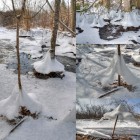
These photos taken by Ken Scott on April 14 show ice skirts formed near the bottom of trees and shrubs in northern Michigan. The images are posted on the Earth Science Picture of the Day feature produced by NASA’s Earth Sciences Division. This phenomenon was caused by heavy springtime rain falling on top of several inches of snow. As the water receded, temperatures in the area plunged — causing top layer of water (also the coldest layer) to freeze while the layers below the surface were more insulated and melted away. Have you ever seen an ice skirt before?

Researchers warn of health and environmental concerns surrounding livestock farms

By Kate Golden
Wisconsin Center for Investigative Journalism

Six leading researchers at Johns Hopkins University’s Bloomberg School of Public Health are warning northeastern Wisconsin rural residents that over-application of manure at intensive livestock operations could cause them a host of health problems and damage the environment. The authors, all at the school’s Center for a Livable Future, cited dozens of studies, including one 2005 article suggesting that 71 percent of Wisconsin dairy farms generate more manure than needed by the cropland where it’s applied. A growing body of evidence has implicated the generation and management of manure from intensive livestock operations in the spread of infectious disease (including antibiotic-resistant strains), the introduction of microbial and chemical contaminants into ground and surface waters, impacts to air quality, and the wide range of adverse health, social, ecological and economic outcomes that result from these events, according to the March 27 letter. The letter was requested by Kewaunee CARES, a Kewaunee County water quality advocacy group that has criticized the intensity and oversight of large dairies in the area. The county is in northeastern Wisconsin, which has some of the densest livestock farming in the state.

Authors “Canvas Detroit” for art’s impact on the urban environment

In “Canvas Detroit,” Nichole Christian and Julie Pincus profile the Motor City’s brightest and most diverse of up and coming street artists. From murals on boulevards to grass sculptures, their work can actively improve the urban environment and shine a light on previously ignored and abandoned cityscapes. Detroit is a city that needs “problem solving,” Christian says, and art won’t solve it all. But the city is fostering a wickedly creative atmosphere that is ripe for revitalization. ­Christian recently explained to Great Lakes Echo the importance of street art and how it can revitalize a city.