Nearshore
Mr. Great Lakes: Dragonflies, beach wellness, Farm Bill help
|
Mr. Great Lakes explains new Great Lakes help from the 2014 Farm Bill and the search for an endangered dragonfly. More from Jeff Kart here.
Great Lakes Echo (https://greatlakesecho.org/tag/agriculture/page/14/)
All stories related to farming, including urban agriculture.
Mr. Great Lakes explains new Great Lakes help from the 2014 Farm Bill and the search for an endangered dragonfly. More from Jeff Kart here.

They hope to overcome climate and other hurdles to produce leaner cuts increasingly demanded by consumers.

Spraying manure on farm fields while rare now has taken on new urgency as more large dairy farms consider the practice.

The concern is whether contamination left by the Velsicol Chemical Co. in St. Louis, Mich., has longterm health consequences for the county’s residents more than 40 years later.
Pig farmers in Michigan and around the nation are losing piglets to a virus that is easily spread and almost always lethal to very young animals. So far, it’s killed over six million piglets.
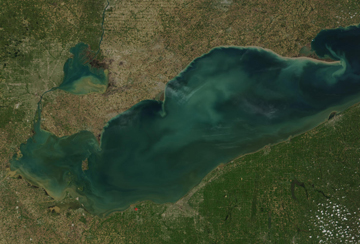
The IJC recommends halving the phosphorus entering the Great Lakes from farms, sewers and lawns. The public trust is a blueprint for action.

Farming feels the lingering effects of the polar vortex in some parts of the state as cold temperatures continue into spring.

Food entrepreneurs in Michigan could take an idea to a frozen meal on the shelves of your grocery store using a proposed mock production line.
Proponents hope to generate an additional $300 million to $400 million in sales and 1,000 jobs annually at the center proposed near Lansing.
The center would be one of a kind targeting medium-sized businesses.
Read more.

By Kate Golden
Wisconsin Center for Investigative Journalism
Six leading researchers at Johns Hopkins University’s Bloomberg School of Public Health are warning northeastern Wisconsin rural residents that over-application of manure at intensive livestock operations could cause them a host of health problems and damage the environment. The authors, all at the school’s Center for a Livable Future, cited dozens of studies, including one 2005 article suggesting that 71 percent of Wisconsin dairy farms generate more manure than needed by the cropland where it’s applied. A growing body of evidence has implicated the generation and management of manure from intensive livestock operations in the spread of infectious disease (including antibiotic-resistant strains), the introduction of microbial and chemical contaminants into ground and surface waters, impacts to air quality, and the wide range of adverse health, social, ecological and economic outcomes that result from these events, according to the March 27 letter. The letter was requested by Kewaunee CARES, a Kewaunee County water quality advocacy group that has criticized the intensity and oversight of large dairies in the area. The county is in northeastern Wisconsin, which has some of the densest livestock farming in the state.
Mr. Great Lakes (Jeff Kart) reports from Bay City, Michigan’s Delta College Q-90.1 FM. Mr. Great Lakes, 4.11.14 by Great Lakes Echo
This week, Kart discusses a coalition to end the use of manure as fertilizer in winter, a Lake Huron Watershed Summit and issues with solar panel glare. Text at Mr. Great Lakes