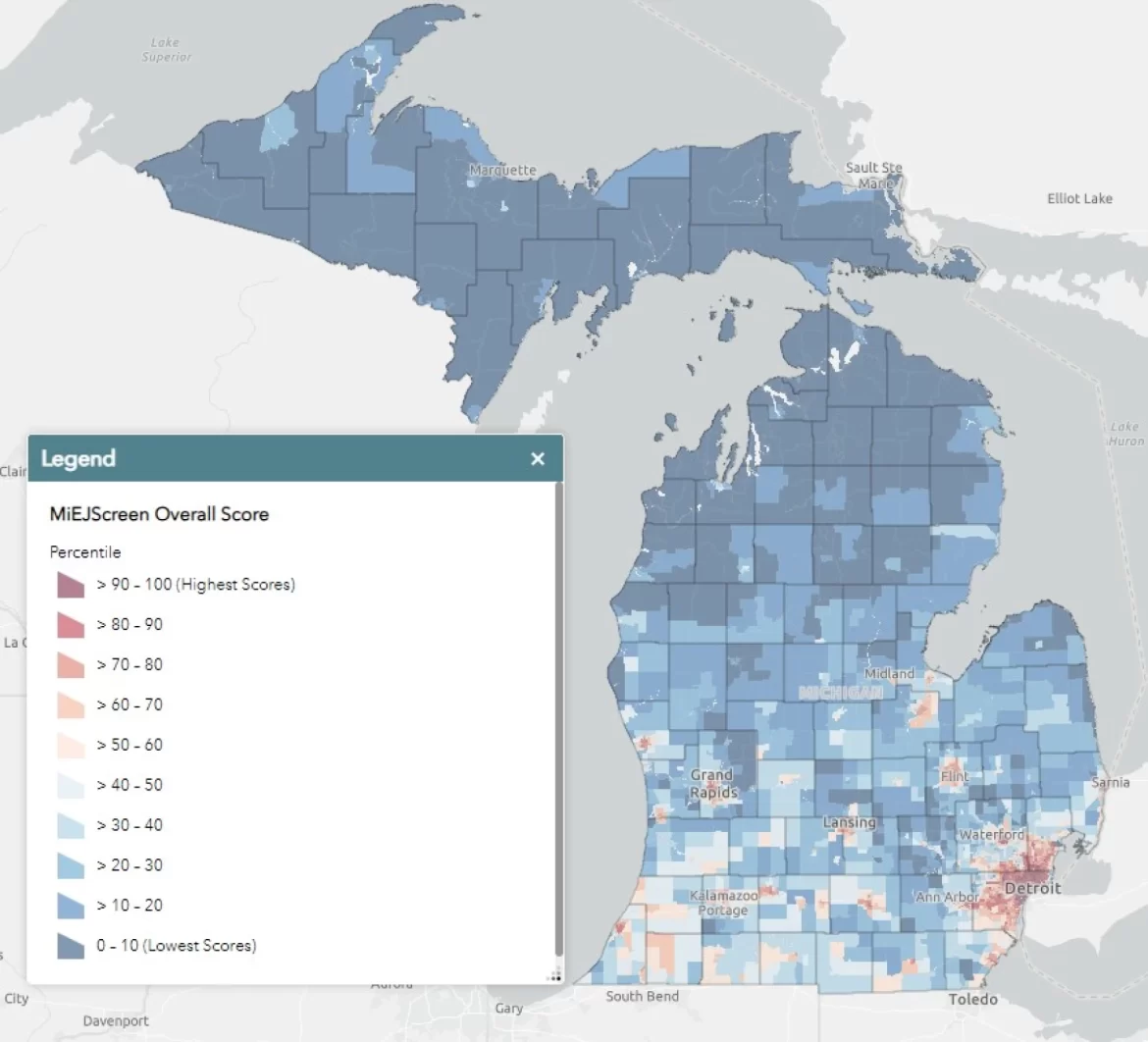
ENVIRO JUSTICE DATA MAP: MiEJScreen is an online tool that maps how health and socioeconomic factors intersect with environmental contamination. Source: Michigan Department of Environment, Great Lakes and Energy

Michigan updates data sharing tool on environmental justice

By Elinor Epperson

Michigan’s Department of Environment, Great Lakes and Energy has updated an online tool that maps which communities may be most susceptible to adverse effects from pollution. The department first released MiEJScreen as a draft in 2022, but released an updated version in early August after seeking public comment. It says it hopes the tool will make it easier for advocates, residents and government officials to understand how environmental contamination affects different populations in their community. The tool combines data about health, socioeconomic and environmental factors to determine which communities are at higher risk of adverse effects from pollution. The data reflect what residents have known for a while, Regina Strong said.


Arts & Scraps: Reusing materials to combat climate change

By Jada Vasser

Reusing materials in creative ways is a lifelong obsession for Ang Adamiak – one that led her to launch a nonprofit. Even though these days she says she’s mostly “in an office writing grants” while her staff is out doing “interesting work,” building partnerships around the sustainable reuse of materials still fuels her. “We’re always looking for ways that we can be in relationship with other organizations, whether they’re bigger or smaller than us,” she told Planet Detroit. Peg Upmeyer launched Arts & Scraps in 1989, and Adamiak has served as its executive director since 2018. The organization aims to bring the people of Detroit together by “providing reused materials and educational resources to promote sustainability and creativity.”

The nonprofit serves the community through its Creative Reuse Community Store and educational STEM programs.

And now, Arts & Scrap’s model for reusing materials and reducing waste is part of the city’s effort to combat climate change as part of the Detroit Climate Strategy. 

The city awarded Arts & Scraps a $5,000 climate action project grant to reach more families through the nonprofit organization Brilliant Detroit.

IMAGE: Deaf and hard-of hearing youth prepare seeds for a new community garden. Image courtesy of Jurmel Mitchell Sr.

Deaf and hard of hearing kids have a role in climate resilience

By Jada Vasser

Six years ago, the Association for the Advancement of Deaf/Hard-of-Hearing was founded by four mothers who wanted to create change and educational programming for their deaf children and community. “We are dedicated to improving the educational and occupational outcomes of deaf/hard of hearing youth and young adults by creating more accessible educational and occupational experiences,” co-founder and chief operating officer Toni Cannon-Mitchell told Planet Detroit. Now, with the support of a $5,000 City of Detroit grant, Cannon-Mitchell is expanding that mission to include climate equity, with a focus on healthy eating and growing one’s own food. The grant supports community projects that advance the city’s climate strategy by creating climate resilience, energy efficiency and food waste reduction. The project will create a community garden that produces cleaner air and food.

Green infrastructure job trainings aim to support growing field

By Elinor Epperson

As more green infrastructure projects are installed across the state, more workers are needed to maintain them. Friends of the Rouge, a Detroit-area nonprofit that manages the River Rouge watershed, is offering a short course about maintaining green infrastructure like rain gardens. The course is an opportunity for workers to expand their job skills and contribute to green projects in the metropolitan area. Cyndi Ross, the restoration manager at Friends of the Rouge, said more green projects in the city means more trained workers are needed. “It’s in demand, and the demand is growing,” she said.

Every summer, toxic algae blooms form on Lake Erie, posing a health risk to humans and animals. Image: National Centers for Coastal Ocean Science

Experts predict moderate Lake Erie toxic algae bloom

By Gabrielle Nelson

Lake Erie’s annual algae bloom has begun to form weeks ahead of schedule off the coast of southeast Michigan, but scientists say they expect only a moderate bloom this year. “There was scum off Monroe,” said Richard Stumpf, a National Oceanic and Atmospheric Administration oceanographer who leads the federal government’s bloom forecasting effort. “It’s not huge now, about 20 square kilometers (7.7 square miles), but it has actually started up in that area.”

Cyanobacteria, known as blue-green algae, fouls hundreds of square miles of western Lake Erie every summer, typically from July to October. The putrid, sometimes toxic, blooms pose a risk to human and animal health and the region’s tourism economy. Under the right conditions, they produce harmful toxins that can sicken humans and kill pets.

: Record-setting heat waves are becoming more frequent due to climate change. Image: JJ Gouin/Adobe Stock

Heat waves are a sign of ‘creeping changes’ in climate, expert says

By Elinor Epperson

There’s no easy way to say it: The heat is only getting worse. Extreme heat events in the Great Lakes region will only become more frequent as climate change warms the oceans, lakes and air, a University of Michigan climate expert said. And the earlier that heat waves start each season, the more there may be in the months to come. Richard Rood is a professor emeritus at the University of Michigan Department of Climate and Space Sciences and Engineering. He said extreme weather will change what feels “normal” for each season.