By Lillian Williams
Editor’s note: This is one in a series of stories coming out of the 2026 conference of the Society of Environmental Journalists in Chicago.
Water and air pollution caused by steel production has been negatively affecting residents of Northwest Indiana for over a century. Environmental advocates say the damage continues.
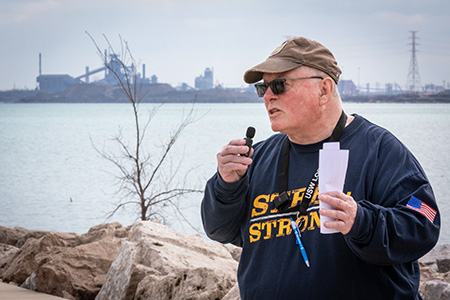
Terry Steagall works with Gary Advocates for Responsible Development. He said he witnessed significant water pollution during his 41 years working in steel mills.
“Our shop was right off the Indiana Harbor Ship Canal, one of the most polluted bodies of water on the Great Lakes,” Steagall said. “They’ve had to basically dredge it so the boats going through wouldn’t drag up the PCBs and other chemicals.”
According to the Environmental Protection Agency, PCBs (polychlorinated biphenyls) were used in plastics, electrical equipment and motor oil. PCB production was banned in 1979 because of possible health risks.
Pollution also adversely affects the Indiana economy, according to Steagall.
“This place at one time used to flourish with perch, and there used to be commercial fishing out here that no longer is happening,” Steagall said during a recent Society of Environmental Journalists field visit to Gary.
According to Industrious Labs, an organization that works to reduce pollution caused by industries, steel production causes significant air pollution, releasing chemicals like benzene, lead, nitrogen oxides and sulfur dioxide.
Gary is home to the steel mill Gary Works. The city’s population has dropped from over 150,000 in 1980 to under 70,000 during the 2020 census.
“It’s the people that work in the mill, and it’s the fence-line communities that are really impacted – but it also goes further,” Steagall said. “There’s no magic dome over Gary Works. That stuff goes throughout Northwest Indiana, depending on how strong the wind is and which direction it’s blowing.”
Industrious Labs reported that air pollution from steel production has caused 145,933 cases of asthma in Indiana.
“You’re never going to redevelop downtown Gary until you clean the environment up there because nobody’s going to move there,” Steagall said.
“They got steel mills on two sides and a refinery on another side and a chemical plant on the other side,” Steagall said. “They’re living in a toxic hole.”
Megan Robertson is the executive director of Indiana Conservation Voters and was raised in Northwest Indiana.
“It’s kind of an industrial wasteland,” Roberston said. “I grew up here. It still shocks me when I drive through.”
Robertson said she thinks steel mills provide a good living for workers.
“The steel mills are some of the best jobs because they’re union jobs, and you can make a really good living for your family,” Robertson said. “But there’s also physical and environmental sacrifices.”
These sacrifices include diseases, according to Robertson.
“If you work in a coke plant, you’re more likely to end up with diseases,” she said. “It doesn’t take a study or a rocket scientist to understand that.”
Coke is used in steel production as fuel for blast furnaces. It is made by heating coal at hightemperatures.
The EPA classifies emissions from coke production as a Group A carcinogen, meaning they are proven to cause cancer.
Ariana Criste, the communication lead for steel-related topics at Industrious Labs, said many steel workers came to Indiana in search of a better life, including Eastern European immigrants and Black families who fled the Jim Crow South.
“For many of those families, a steel worker job here was a ticket to the American middle class,” Criste said. “A house, a pension, a future for your kids.”
Robertson said that’s no longer the case.
“We used to have 65,000 jobs in these steel mills, and that number has been decreasing over the last 20 or 25 years,” Robertson said. “We see that number going down, and we see the communities around suffering because of it.”