By Carly Carter
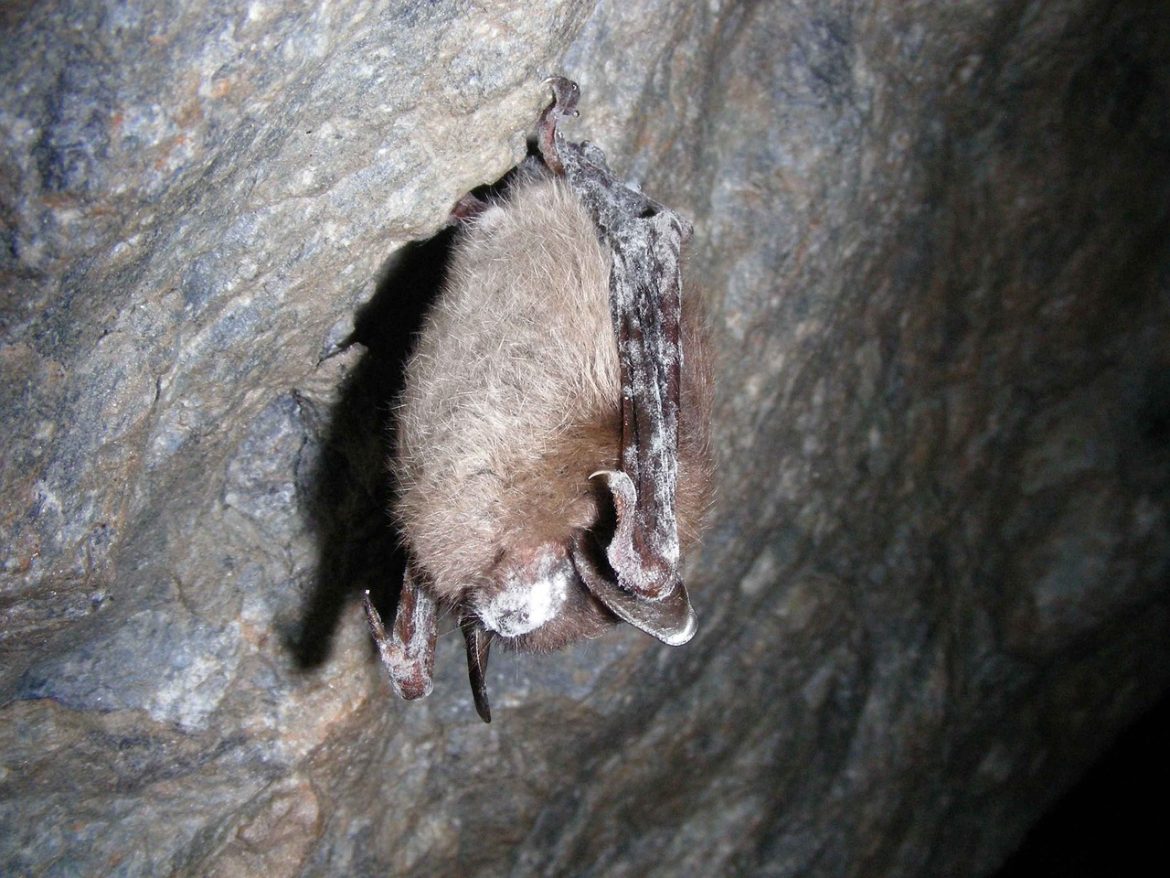
White-nose syndrome (WNS) has been confirmed – or is suspected – in approximately 40 states, including those in the Great Lakes region, according to the White-Nose Syndrome Response Team led by the U.S. Fish and Wildlife Service.
The disease primarily affects hibernating bat species. Out of the 47 bat species in the U.S. and Canada, 12 have been confirmed by USFWS to have symptoms of WNS.
“WNS originated in Eurasia and was identified in New York around 2006,” said Cori Sharp, a doctoral student at Michigan State University’s Center for Systems Integration and Sustainability.
According to a recent study led by Sharp on the endangered Indiana bat (Myotis sodalis), WNS is caused by a cold-loving fungus that can be transmitted by both human activity and migrating bats. In many affected populations, mortality rates exceed 90%.
“In cases of confirmed endangered species or white-nose syndrome, caves are closing in the United States,” Sharp said.
Cave closures by the Minnesota Department of Natural Resources are intended to temporarily prevent disturbances during bat hibernation, allowing populations to recover in caves. This measure is less consequential in northern states, where bats hibernate exclusively during winter months.
“WNS arrived in Minnesota in the winter of 2015 or 2016. That’s when we first confirmed the disease in the state, but we had confirmed the fungus was in the state a few years prior,” said Melissa Boman, a mammal specialist at the DNR.
Boman also leads bat monitoring and survey efforts for the Minnesota Biological Survey.
According to the WNS Response Team, the disease has been confirmed in most states and provinces. Arizona, Nevada, California, Utah, Louisiana and Canada’s British Columbia harbor the fungus, but have yet to have confirmed cases of the disease.
The cave-dwelling, light-averse fungus, Pseudogymnoascus destructans, thrives at temperatures between 53.6 to 60.44 degrees Fahrenheit (12 to 15.8 degrees Celsius).
In Minnesota, Soudan Underground Mine and Mystery Caves, both state parks, experienced population declines of 99% and 94%, respectively, compared with pre-WNS levels, Boman said.
Aside from these sites, Minnesota lacks large hibernacula – places where large numbers of bats congregate to hibernate.
“Bats from [Eurasia] coexist with this fungus in the cave system. They don’t appear to experience mortality like our bats do in North America,” Boman said. “Essentially, the thinking is that this fungus at one point had moved through that population but has been coevolving so the fungus is no longer detrimental to bats.”
Partnering with Rutgers University, researchers in Minnesota have sought to improve survivorship in WNS-affected bats by using ultraviolet lights to kill off the fungus, according to Boman.
Sharp’s research employs a metacoupling framework, which examines how global, regional and local systems interact and influence one another simultaneously.
According to Sharp’s Indiana bat study, the species’ survival depends on multiple factors, ranging from local hibernation conditions to regional land use and global human interaction.
When considering compromised populations, the “green-green dilemma” often pops into the minds of those working toward conservation, Sharp said.
An example of the “green-green dilemma” is that wind turbines generate energy without producing air pollution – benefiting the broader environment – but can pose risks to bats and birds.
Boman described it an “emerging issue”: While the four species of hibernating bats in Minnesota are susceptible to mortality from WNS, the remaining four species – migratory bats – are likely to die from collisions with wind turbines.
These losses could have consequences beyond the bats themselves, affecting ecosystems and agriculture systems that rely on their role as insect predators.
“Female bats who are reproducing tend to eat their body weight in bugs,” Boman said. “That starts to add up when you think about how many bats are on the landscape.”
Sharp said the loss of bats due to WNS and other environmental factors could lead to increased reliance on pesticides, which are costly and pose risks to both human health and the environment.
Bats not only play a critical role in managing insect populations in agricultural systems, but they also contribute to forest health.
“There’s a lot of tree-boring beetles and insects that will defoliate and eat the leaves of young growth and new trees,” Boman said, “Bats keep forest health ecosystems balanced by consuming those insects who may damage a tree to a point where it won’t survive.”
Despite the threats bats face, the attention brought by white-nose syndrome has also shifted public perceptions of them, Boman said.
“Pre-WNS, maybe 20 to 30 years ago, bats were seen as vermin, as very scary, very negative animals,” said Boman, who continues to monitor bat populations across the state. “I think what we’ve seen from WNS is a new appreciation and new interest in studying these animals.”