By Riley Wilson
Ice covering the Great Lakes does more than just signal winter.
Scientists have discovered that it stores organic carbon, which is released in a burst during spring melt, fueling the lakes’ ecosystems. As climate change reduces ice cover, researchers say this seasonal surge of energy may be shrinking, with uncertain consequences for these freshwater systems.
Dissolved organic matter (DOM) is a mixture of material from decaying plants, algae and bacteria found in all bodies of water, serving as a key source of energy for aquatic ecosystems.
According to the United States Geological Survey, DOM is important because it is one of the most significant sources of bioavailable organic carbon that organisms can use in these environments.
In large freshwater systems like the Great Lakes, DOM is closely tied to seasonal changes in biological activity. A recent study published in the Journal of Geophysical Research: Biogeosciences found that ice cover temporarily stores this material, releasing it in a surge during spring melt.
When bodies of water freeze, DOM becomes trapped during ice formation and is stored over winter. As ice forms, shifts and melts, it can redistribute that material across different parts of the water column.
With less ice cover, there may be reduced storage and a change in the timing of DOM release. This could alter when and how organic matter becomes available, with potential implications for seasonal ecosystem dynamics.
Study author Marguerite Xenopoulos, professor of biology at Trent University in Petersborough, Ontario, Canada said the study’s findings highlight that winter and ice cover are active components of the carbon cycle, rather than inactive periods.
Ice processes significantly influence how carbon is stored, transformed and released.
“Winter should be seen as an active and important season, where key transformations and storage of organic matter occur, setting the stage for biological activity in the spring and beyond,” Xenopoulos said.
Xenopoulos emphasized that the research suggests that winter processes should be included in monitoring efforts. Incorporating ice-related dynamics, she said, could improve predictions of water quality, carbon cycling and ecosystem responses to climate change.
Without winter data, scientists cannot fully understand or anticipate how these changes affect aquatic ecosystems.
“How can you understand a story if you only read half the book? That’s how we’ve been studying the Great Lakes—ignoring winter, reading only half the book,” Xenopoulos said.
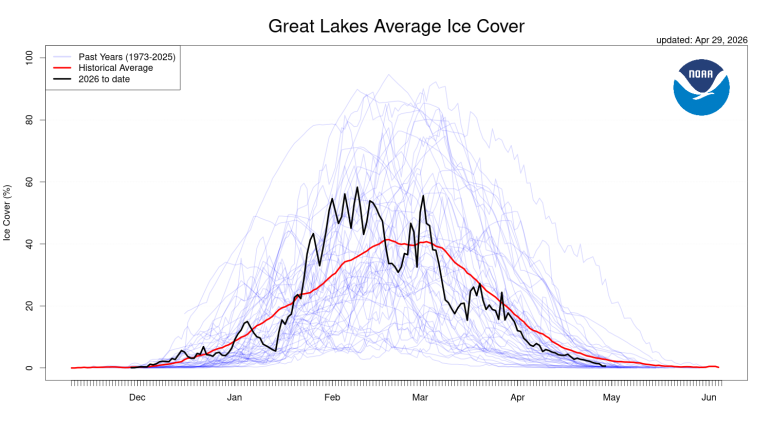
As the climate warms, ice cover on the Great Lakes has generally declined over recent decades. This creates a threat to the region’s seasonal carbon cycling and the ecological processes that depend on it.
Casey Godwin, study author and associate research scientist at the Cooperative Institute for Great Lakes Research (CIGLR) at the University of Michigan said the effects of reduced ice cover on the timing and intensity of spring carbon inputs are still not fully understood.
Godwin said winter research and monitoring are difficult to perform safely using the same methods used during spring or fall, which has limited researchers’ ability to collect baseline data needed to understand long-term trends.
“One of the motivations for performing this study was to demonstrate the potential for collaborative networks of researchers to accomplish sampling that no single group could do on their own,” he said.
Godwin emphasized that declining ice cover is one of the most urgent issues facing the Great Lakes because it affects multiple parts of the ecosystem and has implications for communities that rely on the lakes.
He explained that ice cover plays an important role in fish spawning for some species, influences lake-effect snow on land, affects navigation on the water and supports winter recreation across the region.
When asked whether there are specific areas of the Great Lakes where these effects are more pronounced, Godwin said scientists do not yet know the answer, underscoring the need for greater investment in monitoring and research.
“In this study, most of our sampling was performed closer to shore in areas we could access safely by traveling across ice. Investment in more widespread monitoring of winter conditions in the Great Lakes would allow us to better answer important questions like this,” he said.
As scientists continue to research the impacts of DOM, they warn that declining ice cover could reshape how carbon is stored and released across the Great Lakes.
Improved winter monitoring will be essential for understanding how carbon cycling changes under constantly shifting ice conditions.