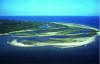
A toxic blue-green algae bloom drifting around the Lake Erie Islands this Labor Day weekend did nothing to deter tens of thousands of visitors to Put-in-Bay, Ohio.
They were anxious to see the fleet of tall ships re-enacting the 1813 Battle of Lake Erie.
Throughout the summer Great Lakes Echo will feature an occasional series of public service announcements produced by Michigan’s Ottawa County Health Department to promote clean beaches. This one reminds swimmers not to treat lakes like a bathroom. Though the card features a child with a dirty diaper, children aren’t the only cause of the problem. A recent survey from the Center for Disease Control and Prevention showed that swimmers of all ages contribute to water contamination. Human waste in water can lead to recreational water illnesses, spread by contact with contaminated water in lakes, rivers, oceans and even chlorinated pools or hot tubs, according to the center.
Tensions have sprung up in Wisconsin over how to allocate finite water resources to many legitimate uses: municipal water supplies, industries, irrigation, private wells, lakes and streams.
Michigan’s recycling rate is lowest in Great Lakes region by Great Lakes Echo
At 20 percent, Michigan’s recycling rate is 10 percent lower than the regional average. Many people around the state are hoping to change that. In 2012, Governor Rick Snyder identified increasing Michigan’s recycling rates as a priority for his administration. Michigan Recycling Coalition executive director Kerrin O’Brien discusses what a comprehensive recycling plan might include. Also this past March, the Keep Michigan Wolves Protected coalition submitted some 255,000 signatures in a bid to overturn the law passed by the Michigan legislature that put wolves on the list of game species. The Senate
soon passed another law that essentially circumvented the petition. Now, the group is trying again with a second referendum drive. This time, the president of the Human Society of the United States was in Michigan earlier this week to lend his support. We spoke with HSUS president Wayne Pacelle about the issue. This environmental segment of Current State is supported by Michigan State University’s Knight Center for Environmental Journalism. For more news of the Great Lakes environment, you can check out GreatLakesEcho.org
Nationwide, there are 1,320 final sites on the Environmental Protection Agency’s National Priority List of waste sites that have released or can release hazardous contaminants. They are either awaiting or undergoing cleanup. Sites can be deleted from the list when “no further response is required to protect human health or the environment,” according to the EPA. Each site is scored through the Hazard Ranking System on a scale from 0-100. The higher the score, the greater threat they represent.
Persistent algae blooms are wreaking havoc on the annual $11.5 billion lake tourism industry. But state elected officials and government agencies are making headway with new tools to reduce nutrients from farms and cities that are causing the blooms.
With Detroit’s economic woes in national headlines it is significant that some of the city’s assets are, well…liquid. Today, Great Lakes Echo and our partner, WKAR’s Current State public affairs program, launch a series of stories exploring the Detroit waterfront. They are remarkable stories of recovery and promise. They include a push to “daylight” the city’s ghost waters and soften its shoreline. They describe some of the best fishing in the world and report on efforts to repair longtime damage to an industrial riverfront. These are important stories for a city struggling to remake itself.
Water attracted early settlers to Detroit and water fueled its growth. Now it’s an important asset to the city’s recovery. Join us in the coming weeks as we explore Detroit’s waterfront: Challenges and opportunities.
Great Lakes United and the International Institute of Concern for Public Health recently released a map detailing nuclear power production sites in the Great Lakes region. It includes operating, closed and proposed plants in the United States and in Canada.