Echo

Conserving Great Lakes Water: Not on our watch
|
Lesser known but arguably more important than preventing diversions to Las Vegas, the Great Lakes Compact requires the states to develop water conservaton plans by 2010.
How’s it going?
Great Lakes Echo (https://greatlakesecho.org/2011/06/page/4/)
Lesser known but arguably more important than preventing diversions to Las Vegas, the Great Lakes Compact requires the states to develop water conservaton plans by 2010.
How’s it going?

A long winter and a wet spring are a recipe for manure management headaches and potential water quality threats in the Great Lakes region.

Proposed legislation in Michigan may encourage the use of small-scale clean-energy devices by exempting them from property taxes.
Local governments say they must weigh clean energy’s impact on economic development against the loss of property tax revenue.
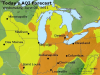
Unseasonable heat and smog are smothering Great Lakes states. Many cities experienced record-breaking temperatures with ground-ozone that are unhealthy for children, older adults and people with lung disease.

This week the farmers begin building a second greenhouse and installing solar panels to support geothermal heat.
They start planning a rain cistern to capture rainfall

Officials in Ontario are preparing for a possible Asian carp invasion in the Thames River by performing a tabletop exercise with the Ministry of Natural Resources and Fisheries and Oceans Canada. The simulation demonstrated that in the event of such an invasion, nets would be placed upstream and downstream to catch fish; an alternate plan is to use electrical current to catch the carp, according to Treehugger. This invasion concern stems from repeated incidents of people trying to bring trucks of the species into Toronto to sell. Similar techniques are being planned in the U.S. as well, as announced in the Monitoring and Rapid Response Plan for Illinois Waters. Are these tabletop exercises adequate in anticipation of a potentially devastating disaster?

Municipalities throughout Michigan are focusing on street lighting to save money and reduce energy consumption.
Some communities may overhaul street light systems to more energy-efficient ones. Others may reduce the time the lamps are lit.
A number of Michigan counties have fewer healthy food outlets than the national average, a new study shows.
The overall percentage of counties’ access to healthy foods in the state is 73 percent, while the national benchmark is 92 percent, according to County Health Rankings, complied by the Robert Wood Johnson Foundation and University of Wisconsin Population Health Institute.

Product stewardship, a concept which puts environmental responsibility on consumers and producers, is one of the focuses of this year’s round of pollution prevention proposals to the Department of Environmental Quality (DEQ), which will award $50,000 to the winning community to implement its initiative.