Skip to content
  • logo
  • logo
  • Home
  • Solutions
  • Agriculture
  • Water
  • Cities & Suburbs
  • Nearshore
  • Recreation
  • Wildlife
  • Energy
  • Waste
  • About
  • Contact

Great Lakes Echo - Environmental news of the Great Lakes region

Great Lakes Echo (https://greatlakesecho.org/category/water/page/12/)

  • Home
  • Solutions
  • Agriculture
  • Water
  • Cities & Suburbs
  • Nearshore
  • Recreation
  • Wildlife
  • Energy
  • Waste
  • About
  • Contact
Subscribe

Water

Includes water quality, quantity and use.

  • Related Topics:
  • Water
  • Echo
  • Water quality
  • Great Lakes
  • Commentary
Urban

Competing visions for a famed river in a Midwest hotspot: Part 2

By Great Lakes Echo | August 30, 2019

This 2-part series explores two projects on Michigan’s Grand River and how a fast-growing region is struggling to define a relationship with the river it was built around.

Water

Competing visions for a famed river in a Midwest hotspot: Part 1

By Great Lakes Echo | August 28, 2019

This 2-part series explores two projects on Michigan’s Grand River and how a fast-growing region is struggling to define a relationship with the river it was built around.

Africa Great Lakes

Large lakes worldwide share many of the same threats

By Ray García | August 19, 2019

By Ray García

Algae pollution, plastic pollution and waste run-off plague the Great Lakes here in the United States. But similar problems also threaten large bodies of freshwater worldwide. The seven African Great Lakes and Lake Baikal in Russia, two of the world’s largest systems of freshwater, also face these problems daily. During the summer, a rapid growth of algae is among the most prominent challenges in Lake Erie and Lake Michigan. These algal blooms harm the lake animals and can harm humans as well.

Water

“Forever chemical” replacements on the rise in the Great Lakes

By Andrew Blok | July 26, 2019

Yet another game of toxic whack-a-mole—this time with PFAS chemicals. Phased-out compounds are decreasing in the Great Lakes, but replacements keep showing up.

Catch of the Day

U.S., Canadian officials seek input on water quality progress

By David Poulson | July 23, 2019

It’s part of a review by the International Joint Commission.
Commentary

Commentary: Universities are an important part of the nonprofit media landscape

By David Poulson | July 23, 2019

Knight Center students, alumni, news networks push environmental news distribution.

Water

A crack in the Great Lakes Compact? Approved water diversion prompts pushback

By admin | July 15, 2019

“The idea that massive water bodies can be permanently transformed is not a fanciful one”

Water

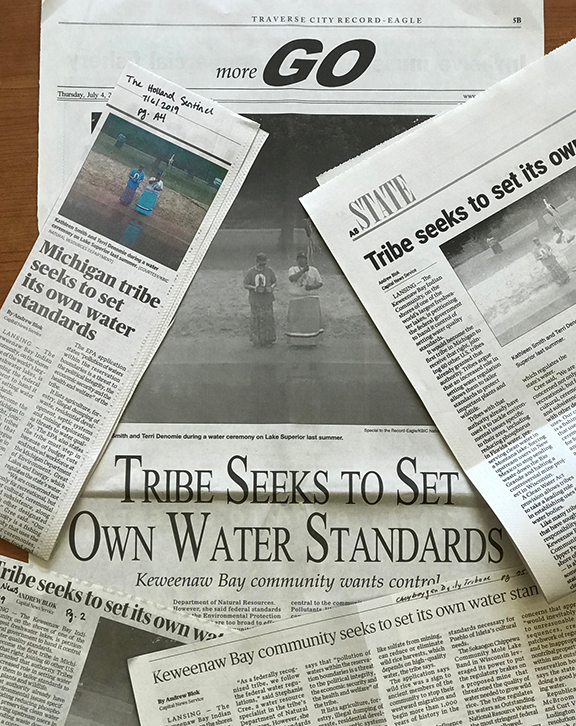
“Our community is a fishing community:” Michigan tribe seeks to set its own water standards

By admin | June 19, 2019

The Keweenaw Bay Indian Community, heavily reliant on fish, berries and wild rice, wants to join the 60 other US tribes who the feds have granted control over setting water regulations.

Commentary

Commentary: US drinking water mostly safe; that’s not good enough

By Joan Rose | May 31, 2019

A grade of 92 is an A at most schools, but for tap water it means that millions of Americans drink water that fails to met federal standards.

Lake Erie algae
Algae

Granting rights to a resource

By Kelsi Kroll | April 29, 2019

Lake Erie Bill of Rights under fire.

Load more articles

About Great Lakes Echo

Environmental news of the Great Lakes region from the Knight Center for Environmental Journalism at Michigan State University.

  • A side-by-side of the historic Portage Canal and modern Portage Canal from an aerial view.
    Restoration of historical site improves quality of life for Portage, Wisconsin residents

    By Joshua Kim Following the completion of segments 1 and 2 of the Portage Canal, local residents and visitors can use the historic site and its amenities following years of disrepair.

  • What herring gulls tell us about plastic pollution

    By Victoria Witke Christina Petalas, a doctoral student McGill University, studies herring gulls to learn about plastic pollution near the St. Lawrence River. Across two studies, she found plastic additives in every bird sampled, which could have human health consequences.

  • Scientists update geological map of northern Wisconsin, Michigan’s Upper Peninsula 

    By Kyrmyzy Turebayeva The U.S. Geological Survey has began large-scale low-level airplane flights over Michigan's Upper Peninsula and northern Wisconsin to obtain high-resolution data on subsurface mineral structures and bedrock composition. The data will be used to create two- and three-dimensional maps to better understand the geological structure at depths of about 10,000 feet.

  • ‘Refusal is insisting on your own terms’: Indigenous activism in the Midwest

    By Isabella Figueroa Nogueira “Indigenous Activism in the Midwest: Refusal, Resurgence and Resisting Settler Colonialism” explores how Dakota and Anishinaabe communities in Minnesota continue their relationships to the land and challenge dominant settler narratives about ownership, belonging and identity.

  • Cannabis workers are developing job-related asthma and some have died, study says

    By Clara Lincolnhol New research says workers picking, grinding and packaging cannabis are developing workplace-related asthma, and two deaths have occurred so far.

  • Swiss researcher studies ‘abandonment tourism’ in Detroit

    By Camila Bello Castro A recent case study of a former “abandonment tourism” business in Detroit found a disconnect between the lived experience of many city residents and the lives of the tour participants who were generally white, younger and more international than most Detroiters and generally first-time visitors to the city.

  • Wolves hunt beavers in Isle Royale National Park, changing the ecosystem

    By Akia Thrower A new study reveals how gray wolves in Isle Royale National Park seasonally alter their habitat preferences to align with beavers’ habitat preferences, a shift that might have implications for the island’s ecosystem.

  • Green clues: Crime-busters turn to moss to help solve crimes 

    By Eric Freedman Tiny pieces of moss can be crime-busters, says a study examining how law enforcement agencies, forensic teams and botanists have used moss to solve murders, track missing people, calculate how long ago someone died and – in a notorious Mason County case – try to locate the body of a baby murdered by her father.

  • Photo of Chen sitting in a chair
    New research in Michigan’s Upper Peninsula shows how invasive earthworms are changing forest soils  

    By Georgia Hill Scientists studying the body size and growth patterns of non-native earthworms in the UP’s Huron Mountains say they are disrupting forest ecosystems. Contrary to popular belief, most North American earthworms are invaders unintentionally introduced during European colonization. They have a significant impact on ecosystems, especially in the Great Lakes region where they affect soil structure, nutrient cycling and biodiversity.

  • Anishinaabe fire practices shaped Great Lakes ecosystems, new research shows

    By Victoria Witke New research shows Anishinaabe fire practices shaped today’s Great Lakes ecosystems. The region’s forests never existed and can’t continue to exist without people – or fire.

  • Great Lakes Echo

Contact Us

Email: GreatLakesEcho@gmail.com
Phone: 517-432-1415

Search This Site

Browse Archives

© Copyright 2025, Great Lakes Echo

Built with the Largo WordPress Theme from the Institute for Nonprofit News.

Back to top ↑