By Mia Litzenberg
Climate change is creating new challenges for Great Lakes coastal communities.
To tackle these hazards, the Niagara Peninsula Conservation Authority launched the Lake Ontario Coastal Resilience Pilot Project last summer.
Over the next four years, the project aims to engage communities in developing a coastal resilience plan.
The plan outlines strategies for improving environmental, social, political and economic conditions to safeguard communities along a waterfront.
In Ontario, coastal climate impacts are evident through increased water levels, erosion and flooding, threatening homes, businesses and essential infrastructure.
Recent climate events have caused billions of dollars in flooding damage to Lake Ontario communities, including torrential rains in 2024 and record-high 100-year water levels in 2019.
“When we talk about most coastal communities down here in Niagara, we’re talking about built environments, natural environments, diversity of agriculture and economy, and also the social connection to the lake itself and the environment,” said Leilani Lee-Yates, the chief administrative officer of the Niagara Peninsula Conservation Authority.
The authority is partnering with Pelee Coastal, Conservation Halton and the Hamilton Conservation Authority on the project. They operate under Conservation Ontario, which represents the province’s 36 conservation authorities.
Conservation authorities are local, nonprofit organizations with jurisdiction over a particular watershed.
They help communities create coastal resilience plans through science-based research to support growth and shoreline protection into the future, Lee-Yates said.
They are also exploring other types of shoreline protection measures.
Nature-based solutions use natural resources to prevent further shoreline erosion, unlike gray infrastructure, which relies on materials like metal or concrete.
The Lake Ontario Coastal Resilience Pilot Project will determine the most optimal course of action, which may use a combination of both techniques.
The authority will also collaborate with the Global Centre for Climate Change and Transboundary Waters and the Great Lakes and St. Lawrence Cities Initiative. These organizations approach coastal resiliency from complementary angles.
“Our side is we’re looking at what are the socio-demographic, economic, governance and policy challenges that these climate imperatives are going to present for governance and community and political action in these areas,” said co-principal investigator Carolyn Johns of the Global Centre for Climate Change and Transboundary Waters .
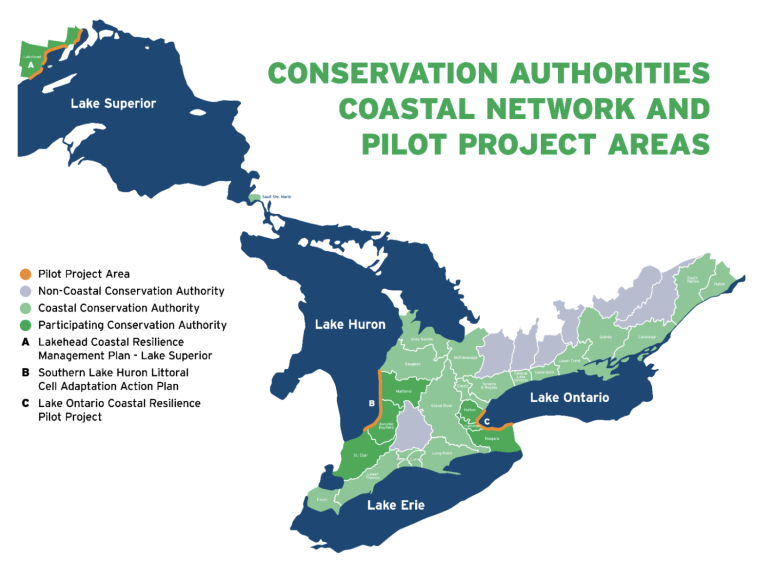
The Lake Ontario Coastal Resilience Pilot Project is one of four pilot projects in the Great Lakes region under Natural Resource Canada’s Climate-Resilient Coastal Communities Program. The multi-jurisdictional collaboration on this project spans northern Lake Superior, southern Lake Huron and western Lake Ontario.
“We’re really interested in populations that may not historically or traditionally be engaged in conservation authority work in watershed work, environmental work and specifically coastal resilience work,” Johns said.
Groups to be included are farmers, developers, anglers, Indigenous communities and youth.
Combined, the four projects have secured $4.1 million in funding. The Southern Lake Huron Littoral Cell Adaptation Plan is the furthest along, with two of its five years completed.
“Part of our project is teasing out what are all the current policies and laws that affect coastal resilience,” Johns said.
Johns and her team are identifying which policies could help local communities become more resilient. They are also examining which policies require innovation and adaptation.
“For instance, they might be designed to regulate flood zones, and those flood zones may have been based on some historical information and not really based on the current climate context,” Johns said.
The Niagara Peninsula Conservation Authority has connected with other diverse partners on the project to achieve these goals. One is the Mississaugas of the Credit First Nation, which “is so happy to join our partners in stewardship to restore, preserve and protect our coastal areas within our treaty territory,” Chief Claire Sault said in an email.
“I’m grateful that we have many valued allies who value this important work and initiative,” Sault said.
The name “Mississaugas” comes from the Anishinaabemowin word, “Missisakis,” which means “many river mouths.” The Mississaugas trace their name to the Trent, Moira, Shannon, Napanee, Kingston and Gananoque rivers.
Part of their vision is to safeguard the environment for future generations, a goal shared by the Lake Ontario Coastal Resilience Pilot Project.
By evaluating the current factors that contribute to coastal resilience in lakes Ontario, Huron and Superior, the Climate-Resilient Coastal Communities Program seeks to share best practices across all Ontario coastal communities.
“It’s very important because the Great Lakes are facing climate change and the communities that are going to grapple with that and need to adapt the most are the coastal communities,” Johns said. “The scale of this is really important because it’s really where the impacts are felt.”
This story was updated on Nov. 2, 2025.