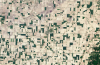
Photo Friday: Land distribution around railroad supply town

By Evan KreagerGreat Lakes EchoThe small town of Reese, just south of the crease of Michigan’s Thumb, was once a bustling supply center at the crossroads of two railways. This true-color image, taken by NASA’s Earth Observing — 1 satellite on May 21, 2012, shows the town at their intersection. The green and white square plots of land also gives insight into some of the area’s history, according to a description of the image produced by NASA. In the late 18th century, the Continental Congress decided how to govern the newly settled lands west of the Appalachian Mountains, according to the NASA description. The Ordinance of 1785 divided the land into townships, and then again into individual square mile plots, creating the colorful collage seen here.


Big Ten’s Eco Efforts: University of Nebraska

In the spirit of our “Green Gridirons” series (but just in case college football wasn’t your thing), the “Big Ten’s Eco Efforts” series highlights creative off-the-field sustainability efforts. Nebraska is the only state in the country that recognizes the last Friday in April as a civic holiday known as Arbor Day. Every year, businesses across the “The Tree Planter State” close down to allow folks to do just that–plant trees. The campus of the University of Nebraska-Lincoln has been marking the holiday for 40 years with a tree planting ceremony on campus where hundreds of trees are planted by students and faculty. The ceremony is part of Focus Nebraska, a week-long event that promotes environmental sustainability, awareness, engagement and activism, said Richard Sutton, professor of agronomy, horticulture and landscape architecture.

Why Small Parks Matter

Ask natural scientists why small parks matter and you’ll hear about habitats, biodiversity, carbon sequestration and buffer zones between developments. Ask the same question to social scientists and you’ll hear about maintaining human connections with nature, centers of community concern, neighborhood identity and healthy outdoor activities. Small parks can even serve a public policy purpose as a political rallying point. That happened last year in Turkey when government plans to develop 9-acre Taksim Gezi Park — one of Istanbul’s smallest parks and among the few remaining green spaces in the city’s BeyoÄŸlu district— triggered sit-ins and national demonstrations. From a humanist as well as scientific perspective, poet-environmental activist Wendell Berry has written that we need not cherish just the great public wildernesses” but small ones as well.

Landscope: Southfield explosion

Now a booming suburb of Metro Detroit, Southfield has come a long way from a small agricultural town.

The city grew from around 18,500 residents in 1950 to more than 78,000 residents in 2000 before declining to 71,758 residents by 2010.

This increase was due to the growth of suburbs, where fresh air and having your own backyard was advertised by real estate agencies, as opposed to city living, where housing was crowded and dense.

Big Ten’s Eco Efforts: University of Wisconsin

In the spirit of our “Green Gridirons” series (but just in case college football wasn’t your thing), the “Big Ten’s Eco Efforts” series highlights creative off-the-field sustainability efforts at Big Ten universities. The F.H. King organic farm at the University of Wisconsin has been growing produce for students to veg out on since 1979. The urban garden is the pride of the sustainability of agriculture program at the Madison campus. Not only does the farm donate to the school’s cafeterias to support late night food runs, but it also donates 500 pounds of produce every year to area food banks, said Meredith Keller, student programs coordinator at the university’s office of sustainability. “Our members participate in all aspects of managing a garden and either sell or hand out fruits and vegetables at locations on campus,” Keller said.