
By Sonja Krohn
Michigan is one of several Midwestern states experiencing unusually dry conditions throughout this winter.
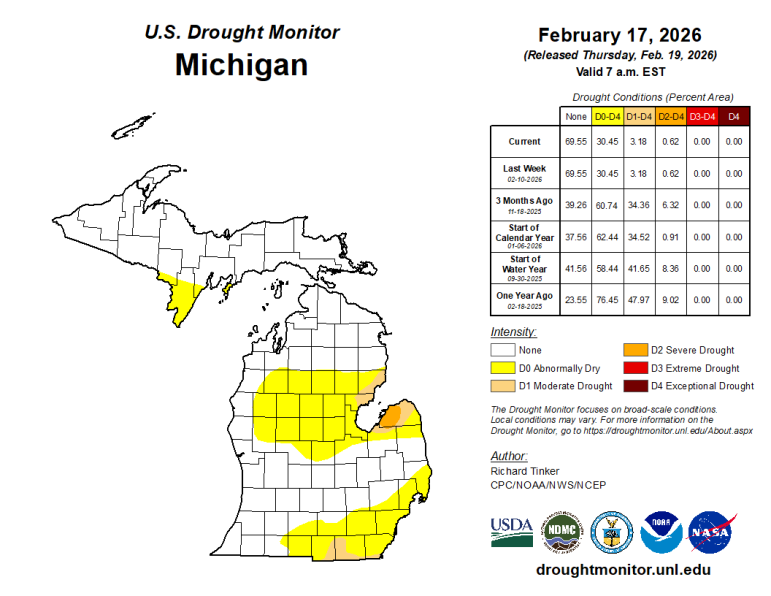
The U.S. Drought Monitor shows abnormally dry to severe drought conditions in 45 Michigan counties, some of them for more than six months.
“A lot of people are surprised about drought in the winter – especially in places that get snow,” said Lindsay Johnson, a climatologist at the National Drought Mitigation Center in Nebraska.
But the explanation is simple.
If colder states go into the winter in drought, that condition tends to persist until the spring, as any moisture they get – in the form of snow – “is essentially locked away because it’s frozen,” Johnson said.
In Michigan, drought conditions started in the warmer months when the lack of precipitation caused dryer soils. That moisture deficit, she said, carried over into the winter.
In colder conditions, “that lack of moisture can’t be corrected typically,” Johnson said. While some snow may have melted recently, Michigan’s ground is still frozen, making it harder for moisture to infiltrate.
On a broader scale, Michigan isn’t the only state experiencing dry conditions.
The U.S. Drought Monitor shows much of the country painted anywhere from yellow and orange to red. While widespread, any of these colors indicate abnormally dry conditions, according to Johnson.
“None of this is normal,” she said.
Tim Boring, the director of the Department of Agriculture and Rural Development, said, “It’s something we’re watching.”

While drought in January and February sometimes correlates with significant conditions going into the spring growing season, he said that doesn’t always happen.
Still, the department is monitoring deeper soil-moisture profiles, “knowing, too, that we’ve had colder-than-average conditions over the last couple of months,” Boring said.
Jerry Miller, the president of the Flint-based Michigan Association of Conservation Districts, said, “Since plants are not growing in the winter, this time is an opportunity for water infiltration and storage in the soil profile.”
That will recharge the soil’s available water capacity for the upcoming growing season as long as the soil remains unfrozen, he said, adding that most often the upper layers of the soil will be frozen.
However, when the soil warms in late winter to early spring, rain will help with recharge of the available water capacity for the upcoming growing season, Miller said.
But “if drought conditions persist after the soil thaws, there may be a deficiency of plant-available moisture during the growing season,” he said.
Association Treasurer Nancy Szikszay, who is a farmer in Genesee County, said crop yield suffers amidst these conditions.
“Without adequate winter moisture, the plants may not fully fill their pods or ears,” she said.
Crop failure is a direct economic impact of drought in the agricultural sector, with costs often passed on to consumers, according to the National Integrated Drought Information System.
However, some areas are more vulnerable than others.
Boring said, “Michigan has a number of soil types in areas that are going to be particularly susceptible to some of these short-term droughts.”
For example: West Michigan has lighter-texture, sandy soils that don’t have the water retention that other soils have.
“Some of those areas saw pretty significant production hits last year because it didn’t rain for a couple of months throughout the growing season,” he said.
The department is taking steps to improve soil quality to increase water infiltration – holding on to water when precipitation does happen – which tends to be during high-precipitation events, Boring said.
“We are implementing a degree of drought resiliency inherent to our soils,” Boring said.
The conservation district association’s Miller said certain conservation practices help farmers reduce the impact of drought conditions by minimizing disturbance of the soil surface. That results in increased water infiltration, reduced surface runoff and enhanced soil health.
That includes practices such as cover crops, no-tillage, residue management and crop diversity, Miller said.
Michigan Farm Bureau manager of commodities and industry relations Theresa Sisung said farmers sometimes put in irrigation, add drainage tiles or consider more drought-tolerant crop varieties to help better manage moisture – whether in cases of drought or excess precipitation.
Still, the Farm Bureau recommends farmers use risk management resources, like crop insurance, to help protect themselves from weather-related challenges.
But while crop insurance assists farmers in the short term, Boring said, there continues to be a “need for [Michigan] to build resiliency and drought-proofing soils.”