By Mia Litzenberg
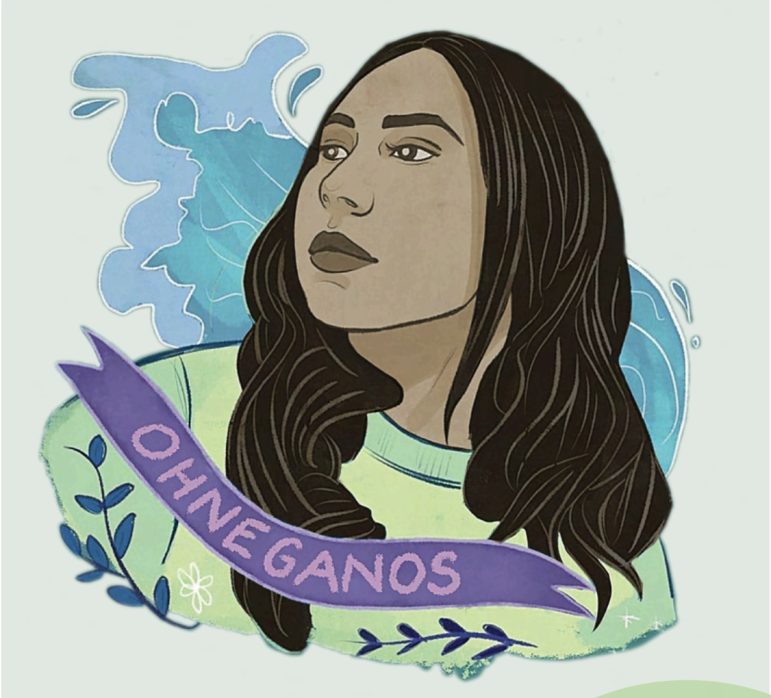
For the Haudenosaunee people of the Six Nations of the Grand River, Ohneganos means “water is life” in the Cayuga language.
The community-led Indigenous water research initiative, Ohneganos Ohnegahdę:gyo, has worked to address water insecurity through holistic capacity building grounded in Indigenous knowledge.
These efforts will be expanded through the new Haudenosaunee Environmental Research Institute with Indigenous partnering hubs across the Great Lakes region.
Developed in partnership with the Global Center for Climate Change and Transboundary Waters and supported by an investment from the Mastercard Foundation, the institute will unify networks between First Nations and universities across the Great Lakes region.
These partners will tackle issues such as contaminated water, the expected decrease in available water caused by climate change and new policies that continue to allow corporate water extraction without Indigenous consent.
“Ohneganos is the template,” said Dawn Martin-Hill, a Mohawk and emeritus professor of Indigenous Studies at McMaster University.
“The institute would be the formalization and sustainability of that template to continue to train grad students, undergrads, community researchers, knowledge holders and Indigenous Ph.D.s to all work together in the same space.”
Another program that helped lay the foundation was the Indigenous Health Research Development Program, where Martin-Hill served on an Indigenous reviewing committee to distribute research funding.
“After working on changing the way Indigenous people are reviewed by creating a reviewing committee, we went from 0.04% to 64% [of Indigenous-led research applications] were approved,” Martin-Hill said.
“That’s our track record in terms of changing the way business is done. We would look at the same with the Indigenous Environmental Research Institute.”
The institute has also partnered with foundations, corporations, universities and organizations to further overcome funding barriers.
Now, Indigenous researchers are redefining the way water security is measured.
“We’re developing those metrics of what we consider to be quality source water, quality ecosystems,” Martin-Hill said.
“We look at things holistically, so we include things like human health, ecosystem health, and we would probably contribute tremendously to water management, water governance and water data.”
Another barrier to water security identified through Ohneganos is the ability to work collaboratively towards solutions with Indigenous and non-Indigenous researchers across the Great Lakes region.
The institute will help fill this gap by leveraging networks beyond Six Nations.
“The problem isn’t that we don’t have enough Haudenosaunee researchers or Ph.D.s. We, in fact, have nearly 50 between Canada and the U.S.,” Martin-Hill said.
“The problem is we’re not working together. We’re basically replicating a system that doesn’t serve our community. It serves our careers and our university colleagues, but it’s not servicing real world problems in our communities,” he said.
To address that situation, the institute would facilitate work placements and internships for graduate students within the community, the seven surrounding universities in Ontario, as well as universities in New York, Michigan and Wisconsin.
“Those would create the longitudinal [long-term] data we desperately need in the community,” Martin-Hill said.
“We would give data collected to community leadership and relevant services, so that they make sure that all data stays in the community and it’s driven by the community.”
A part of community-driven data is practicing knowledge equity, Martin-Hill said. The institute would include a budget to compensate community members for their contributions to research.
The institute also builds on the community’s long-standing fight to protect water by ensuring that young people are equipped to address these challenges.
“It’s not like an overnight out of the blue, we’re just going to create something,” Martin-Hill said.
“We’ve been working towards addressing solutions to some of the modern situations we find ourselves in. Part of that is now elevating the capacity building in our community, and that’s to establish a Haudenosaunee Environmental Research Institute to train the next generation.”
A central part of passing on Indigenous knowledge to the youth is to continue ancestral knowledge that protects the environment.
“A lot of them [youth] are really worried about carrying on and what their future is going to look like, and if they should continue to have families because they’re unsure of how our water is going to continue to be clean,” said the manager of Traditional Ecological Knowledge Projects at Six Nations Polytechnic, Makaša Looking Horse Henry.
“They really wanted skills on what they can do to learn to combat climate change and how they can seek training on water testing and being knowledgeable on how to gather the proper data.”
Looking Horse Henry is a Mohawk and Lakota water protector who led the movements that delivered cease and desist orders against Nestlé and BlueTriton water extraction. She is also Martin-Hill’s daughter.
“From a young age, she took that time to make sure that I knew who I was,” Looking Horse Henry said.
“If I went to a Western school all my life, I would never have gotten that culture education that I have and really know the impact that my voice has because of our matriarchal society. We follow the women, and the women have a really big voice in the community.”
Through this cultural lens, the Haudenosaunee people refer to the Earth as their mother and have a deep spiritual connection with every part of the environment.
“It’s that language, which changes your perspective on how you might treat something, if you’re thinking of the Earth as a resource versus the Earth as your mother,” said Sara Curley-Smith, the Six Nations senior manager of the environment, who is also Mohawk.
These core beliefs are at the center of the holistic approach that Indigenous knowledge takes in water research.
“Sometimes you’ll be faced with people who don’t understand that we have our own knowledge systems because it’s not equally valued in the Western world,” Looking Horse Henry said.
“It’s just known as Indigenous wisdom and not necessarily validated as Indigenous science.”
The historic lack of Indigenous-led water data collection and evaluation that incorporates these knowledge systems is intended to be fulfilled by the institute.
“This is our homeland and we don’t even have access to our own data,” Martin-Hill said. “That’s how colonialism works.”
Achieving Haudenosaunee data sovereignty is one of the long-term goals the institute will address.
“A lot of our data is either not shared or given back,” Looking Horse Henry said. “If we had our own space where we’re able to have our testing and our own protocols and our own metrics and our own place to store our data and people who are able to look after the data, that would be a really huge win,” Looking Horse Henry said.
This story was updated on Feb. 26, 2026.