By Anna Ironside
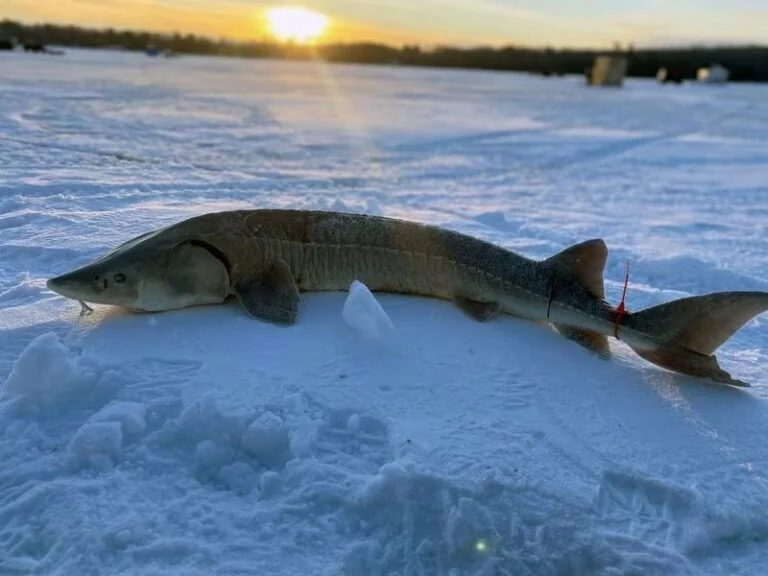
In the early morning hours of Saturday, Feb. 7, roughly 653 registered anglers from 10 states gathered to participate in the 2026 Black Lake sturgeon season.
Within 48 minutes, six sturgeon were caught, and anglers were told that the tightly managed season had already come to a close on the Northern Michigan lake in Presque Isle and Cheboygan counties.
Lake sturgeon (Acipenser fulvescens) are a threatened species in Michigan. With the sturgeon’s slow growth rate and late maturity, regulation is essential to be sure of the species’ survival.
A key contributor every season is Sturgeon for Tomorrow, a citizen-led conservation group that works with the Michigan Department of Natural Resources, Michigan State University and five tribal governments to rehabilitate and monitor the population.
Jay Woiderski, the president of Sturgeon For Tomorrow, said his family has been helping with the ice fishing event since it began in 1948.
At each harvest, Woiderski is there with his team of volunteers to help with communication and setting up tents for the Black Lake Sturgeon Shivaree, a community festival on the ice.
“We run a tree line across the lake to basically make a safe line to get you back and forth across the lake,” Woiderski said.
The group is involved in communicating to the anglers when the season shuts down, he said.
The annual quota for the harvest is based on data and information in the Black Lake Sturgeon Management Plan. Fisheries biologist Neal Godby of the DNR said the total annual harvest is set at 1.2% of the estimated adult population.
“The Black Lake adult sturgeon population is estimated based on tagged fish and returned tagged fish to the spawning run in the upper Black River each spring,” Godby said.
Every spring, he said the DNR monitors the ratio of tagged to untagged adults coming into the Black River to spawn. Based on that number, “we calculate a population estimate,” he said.
That estimate currently supports the total limit of 14 sturgeon.
Seven fish are reserved for the tribes and seven for state-licensed anglers. However, the DNR voluntarily reduced the recreational limit to six this year to prevent overharvesting.
Godby said, “Having that season closure at six allows us to buffer to prevent going over our quota.”
That was due to lessons that were learned over the years with rapid season closures. In 2025, the season ended in just 16 minutes.
Such a quick turnaround presents challenges for officials who must communicate when the quota has been reached.
This year, five of the six sturgeon caught had been previously tagged, a sign that long-term monitoring is working, according to Godby.
“It gives us some important history on the fish,” Godby said. “The data we’ve gotten from spawning returns in our lake surveys show that the adult population is doing well, and there is a good, healthy population of sub-adults in the lake as well.”
Woiderski agreed that the high number of tagged fish reinforces his confidence in the population estimates over the years.
“Because five of the six were handled and tagged previously, that tells us that the numbers they’re basing the population on is actually fairly close,” said Woiderski.
Scott Colborne, an assistant professor at Michigan State who works with the Black River sturgeon facility, said the species’ slow reproductive cycle is central to how harvest decisions are made.
“These fish live an incredibly long time, probably well over 100 years in some cases, and they don’t reproduce very often,” Colborne said. “Females don’t begin spawning until they’re around 25 years old, and even after that, they only return to spawn every five or six years.”
Colborne has been working with telemetry data to better understand how the sturgeon use Black Lake throughout the year and how that information can guide future management decisions.
“The harvest of a relatively small number of fish is reflective of sustainable harvest efforts for a population of animals that realistically probably live well over a century,” Colborne said. “This harvest is based on the best information we have to keep it within a sustainable level for this population.”
With long-term rehabilitation goals laid out in the Black Lake Sturgeon Management Plan, biologists say the work is not over yet, although there are signs of progress. Godby said the target adult population goals outlined in the plan are in reach.
The management plan was a collaboration between the DNR, Michigan State tribal governments, Tower Kleber Limited Partnership and Sturgeon For Tomorrow.
While spawning assessments are done on the upper Black River, tagging efforts and in-lake surveys are important for keeping harvest levels sustainable and tracking the lake’s recovery.
Colborne said, “We’ve been very fortunate in Black Lake. Every indication we have is that the conservation efforts are working quite well, and the population is growing.”
The DNR offers ways for the public to be part of it, Colborne said.
The work of the Lake Huron Citizens Fishery Advisory Committee and the Northern Inland Lakes Citizens Fishery Advisory Committee contributes to community involvement that can influence fisheries management across the region.
With public release events and the Adopt-a-Sturgeon and Sturgeon in the Classroom programs, organizers say they hope education will boost stewardship for a fish that can live for over a century.
“One of the best things to see is how people in the community get excited about these fish and interacting with them and learning more about what we’re doing,” Colborne said.
Right now, agencies are reflecting on the 2026 season as a success in terms of responsibility and conservation.
“Absolutely, I think it was kind of the perfect year,” Woiderski said. “It didn’t happen too quickly, and everything was handled very well.”