After four decades of research, Robert Kowal has identified Packera insulae-regalis, a flower found only on Isle Royale in Lake Superior, as its very own species.

Packera insulae-regalis has been identified as its own species. The flower is found only on Isle Royale in Lake Superior. Photo: Robert Kowal
“It’s like having a baby, except this will live for all time,” Kowal said.
The professor of botany at the University of Wisconsin-Madison has studied the yellow flower since 1972 when a graduate student brought him a sample. He grew it in a test garden and collected data for the next 10 years, finding clues that the flowers are unlike other packera plants.
“I had thought it was a widespread species of the Lake Superior area,” Kowal said.
The plants grow between one and three feet tall, with small yellow flowers about one inch in diameter. Kowal found that although they look like other packera, these Isle Royale packera have different sized flower heads and can reproduce asexually instead of through cross-breeding.
“Gradually it dawned on me this should be treated as a new species,” he said.
In 1998, Kowal walked Isle Royale trails to observe the flower and try to find more of them.
The flowers are only found on Isle Royale in wetland areas near Mt. Franklin, but Kowal said he is studying another possible population in a Canadian national park.
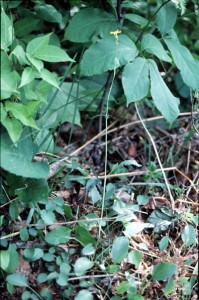
The Isle Royale packera aren't eye-catching, which may help them be preserved. Photo: Robert Kowal
“It’s perfectly logical geographically that it should be there, and based on pictures it may be another population of the species,” Kowal said. “We’ll know by the end of July next year.”
But for now the flower is the park’s only known plant found only on the island, according to Paul Brown, the island’s chief of natural resources for the U.S. Park Service.
Visitors don’t give the flower much attention, Brown said. Park employees don’t advertise its presence or tell people exactly where to find it.
Although the Isle Royale packera grow near a heavily used trail, Brown said the flowers wouldn’t catch most hikers’ attention.

Robert Kowal sits in his garden, where he grew and studied Isle Royale Packera. Photo: Jeff Ballard
“It’s not something people are going to love to death,” Brown said. “It’s something they’ll walk right past.”
The new species isn’t eye-catching and doesn’t have any ornamental, horticultural or medicinal worth, Kowal said. The real value is in the name itself.
“By naming it one can provide some protection for it,” Kowal said. “Wetlands are not liked by humans. They’re either filled in or dammed and made into ponds, and they are being destroyed. By naming it, one can provide an argument for preserving some wetland areas.”
Beyond protecting wetland areas, Kowal is proud to have contributed to science.
“This is something that the common person can appreciate. It’s a new species for all time, unless it goes extinct.”
Hey we’re finding those plants everywhere in Lawton MI. Is it a GMO plant? weird how it was only in one spot and now spreading.. Is there any way I can upload or send photos to you or somewhere?
Awesome! Fascinating and a great job, Bob.
Go Pack Go!
And right here in our own state of MI-great work and congrats!!!
Congratulations! Is it polyploid?
Congratulations~Awesome!!!