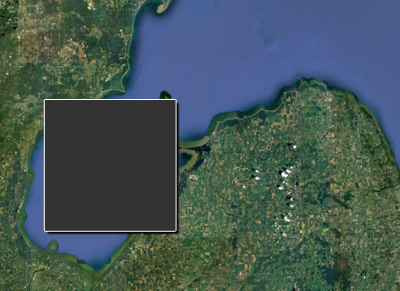
The estimated 488 square miles of parking lots in four Great Lakes states would cover 40 percent of Saginaw Bay. Image: Google Earth
The combined parking lots of four Great Lakes states take up nearly 500 square miles, according to recent estimates by Purdue University.
That’s enough pavement to cover 30 percent of Green Bay in Lake Michigan, 40 percent of Saginaw Bay in Lake Huron or twice the surface of Isle Royale in Lake Superior.
It also contributes to one of the biggest threats to Great Lakes water quality: Urban runoff.
The researchers measured parking lot cover in aerial photographs of 30 randomly selected ZIP codes in Illinois, Indiana, Wisconsin and Michigan. They then scaled those measurements up for statewide estimates, which were published in the May issue of the journal Landscape and Urban Planning.
They came up with 488 square miles across four states, though there could be as few as 370 or as many as 670.
They also estimate that around 45 million parking spaces account for 5 percent of the region’s urban areas. That doesn’t even include the pavement taken up by streets and driveways.
If it did, that would likely mean that there are three parking spaces for every registered vehicle in the four states, said Amelie Davis, co-author of the study.
That’s too many, she said.
“It’s like playing musical chairs, but there are two extra chairs per person in the room, which is ridiculous,” said Davis, who has moved on to a post-doctoral fellowship at Furman University in South Carolina since working on the study.
She’s not the only one who thinks so.
“It’s a good indicator of how absurdly wrong we’ve gotten our development patterns in the past 50 years,” said Steve Hiniker, executive director of 1000 Friends of Wisconsin, a non-profit advocacy group focusing on urban land use.
Those development patterns include rules that require a minimum number of parking spaces to accompany new development but rarely limit the maximum number. That can lead to sprawling lots that sit mostly empty except on the busiest days of the year.
And too much pavement can stress nearby streams.
Parking lots can soup up stream-bound rainwater with pollutants like oil and polycyclic aromatic hydrocarbons, or PAHs, according to another Purdue parking lot study. Some pavement sealants have high levels of PAHs, which are a group of chemicals toxic to aquatic life. Some may also cause cancer in people.
“Thermal pollution” is another problem, said Davis. Parking lot runoff that is warmer than the stream it flows into could cause trouble for cold-water species of fish and insects.
One way to curb growth is with zoning rules that remove minimums and add maximums on parking lot sizes, said Hiniker. That’s already happening in some Wisconsin cities.
But an even better solution would be communities designed with walkability and mass transit in mind, he said.
Americans tend to shy away from that plan, and instead stick to driving and parking as a matter of habit, he said.
“Sometimes I hear people who don’t like transit talking about, ‘Oh, those empty buses. It just drives me crazy.’” he said. “Well, how about these empty parking spots? That drives me crazy.”
Davis’s co-authors on the Purdue parking lot studies are Bryan Pijanowski, Kimberly Robinson, Bernard Engel and Paul Kidwell.
Related story:
Pingback: Great Lakes states’ 500 square miles of parking lots threaten water quality, walkability - Save Maumee
Having read this I believed it was very enlightening. I appreciate
you spending some time and effort to put this content together.
I once again find myself personally spending a significant amount of
time both reading and posting comments. But so what, it was
still worthwhile!
Here is my weblog – Asphalt Driveway Minnesota
Pingback: Michigan joins other Great Lakes states with Complete Streets laws | Great Lakes Echo
Pingback: The List: Week of June 13, 2010 « Michigan's State Historic Preservation Office
Pingback: Access Denied: Sidewalks often obstacles for wheelchairs | Great Lakes Echo
Janice,
Great! It’s the first time I have seen actual numbers of filtered stormwater. Raingardens and bioswales are more than nice – I think they are very effective and if widely accepted, would have a noticeable impact on the quality of our surface waters. We collect rainwater from our roof into rainbarrels and have a raingarden in our little backyard that intercepts runoff before it gets to the subdivision pond. I bet the pond would look a lot different if everyone did this but I don’t know how to make the calculation.
Good article ~ Important subject!
I assisted in writing a Great Lakes Restoration Initiative grant for the St. Clair County Community College in Port Huron, MI. It proposed to surround the majority of campus parking lots with bioswales and rain gardens as well as capture runoff from the main building’s roof. The annual calculations were impressive ~ 23.75 acres of rain gardens and 42.50 acres of vegetated bioswales would have captured and filtered 3,678,688 gallons of stormwater based on our annual rainfall. One of the outcomes of the grant would be to use the campus as a demonstration project. I had visions of leading local planning commissions, city councils, and a variety of legislators on a casual tour I believe would have knocked their socks off! Missed being selected this round, but hope they re-submit it in the next…
Related, 42% of Cook County Illinois (Chicago and nearby suburbs)is covered by impervious surfaces – roads, parking lots, drive ways patios, and roofs.
Some cities even mandate that drive ways be of concrete or asphalt for appearance purposes, I guess.
gw
Raingardens! I’m surprised the authors did not mention the use of raingardens to intercept and filter water runoff before it runs into a drain or directly to a surface water body.
While raingardens are not practical for every situation, they are effective in many, and combined with public transit would have a great impact improving surface water quality.