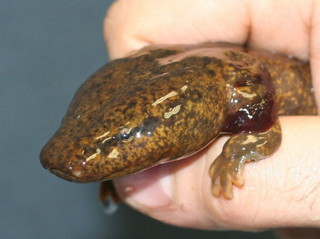
Mudpuppies like this one are growing scarcer in the Great Lakes. Photo: C Valentine, via Flickr
A bizarre salamander and the endangered, clam-like mussel that relies on it got good news recently from Canadian scientists.
Federal researchers found an apparently stable population of mudpuppies in Ontario’s Sydenham River. The research is published in the June issue of the Journal of Great Lakes Research.
Mudpuppies are native to the Great Lakes and have beady eyes, slimy skin and feathery gills sticking out of their necks.
“I find them very interesting animals, but I can see why the general public wouldn’t rate them up there with bluebirds,” said Jim Harding, herpetology specialist at the Michigan State University Museum.
Most of the mudpuppies found in the Sydenham were young, which suggests that the population is stable and could be growing, said study author Tana McDaniels, a researcher with Environment Canada
That’s encouraging for a species that is declining elsewhere across the Great Lakes region.
Mudpuppies have external gills and can absorb contaminants through their skin, so they’re sensitive to pollution, Harding said. They can be killed by a chemical used to control sea lamprey larvae, a parasitic fish. The chemical, called TFM, has wiped out mudpuppies in some tributaries of Lake Michigan.
And mudpuppy die-offs along Lake Huron and Lake Erie could be tied to toxins that build up from algae blooms.
“I would say certainly they’re on the decline,” Harding said. “I don’t see them in as many bodies of water as I once did and they seem to be scarcer for the most part in those bodies of water where I still find them.”
A stable population of mudpuppies in the Sydenham River is not just good news for salamanders. The river could also be home to the only Canadian population of endangered mudpuppy mussels, McDaniels said.
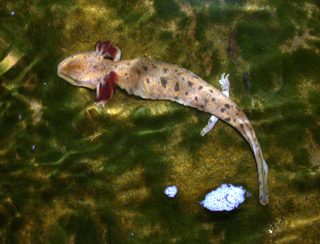
A mudpuppy swims in Kemptville Creek, Ontario. Photo: mcwetboy, via Flickr
The larvae of most mussels attach to fish gills. The attachment provides plenty of oxygen and helps the larvae travel to places it couldn’t reach on its own. The larvae are harmless and drop off after a few weeks.
Each species of mussel generally attaches to a certain species of fish. But the mudpuppy mussel attaches to the gills of the amphibian it’s named for, and is the only mussel with an amphibian host.
The mussels, under pressure from agricultural runoff and invasive species, are listed as endangered or threatened in Canada, Michigan, Minnesota, Wisconsin and Ohio.
The mudpuppy and its mussel are both sensitive to heavy sediment. The Sydenham empties into Lake St. Clair after flowing through an intensely agricultural region of Ontario, picking up soil that has eroded from farmland. All that dirt in the water can make it difficult for mudpuppies to breath and for mussels to eat.
Though the study suggests the muddy Sydenham’s mudpuppies are doing fine, McDaniels said that this one-time survey doesn’t prove that this population is stable. That could take decades of monitoring, she said.
I just caught one thats 12 inch long in traverse city mi on a inland lake ice fishing on long lake we relesed it back into the lake is this a common thing up here
I used to go down to my aunt and uncles cottage on Little Sodus
Bay in Fair Haven New York during the late 60’s when I was in Highschool. I would find giant mudpuppies in my minnow traps during the late fall and early spring. I think the longest one we found over a 3 year period was a tad over 14 inches.
That is exactly what I was thinking. Remember when you couldn’t drop your line off the dock in the middle channel of Harsens Island without catching a couple of mud puppies, haven’t had that experience in 50 years. I to am glad to hear they are doing better. Although you cussed out every one you caught.
When I was young I used to catch them all the time fishing from shore in Lake Erie west of Cleveland.
They were kind of a pest at that time, Have not hooked on in fifty years.
I’m happy that they are still around.
Have a place on Harsens Island on the middle channel. When I was a kid, I’m 63, you couldn’t fish off the dock without catching 2-3. Now I can’t remember the last time I caught one. Can only think they are no longer in the lake.
David, Diane and Kevin:
I am writing a story for Great Lakes Echo about how the super storm affected mudpuppies in the Great Lakes. I would love to interview you or anyone else who has found mudpuppies washed ashore recently. Contact me any time! Thanks so much.
Jennifer Kalish
248-514-0564
kalishje@gmail.com
Found approximately 20 in a 300 foot stretch of Lake Huron beach just north of the canal in Port Huron, Michigan. Washed up after Hurricane Sandy storm. Most were still alive, so put them back into the lake. Had never seen one before!
I was out walking the Lake Huon shore today in Lexington, Mi. we came across 9 or so of these creatures.
They all looked to be dead, all relatively close to same area. Posted picture on face book and someone told me what they were. As if the decline wasn’t bad already now I’m sure it’s worse after the storm.
Just found one today on a Lake Huron Beach, it was barely alive. I beleive it was washed up form the storms from Hurricane Sandy.I dont know if I did the right thing but I put it in a creek near my home in hopes that it would revive, but I think it was to far gone. They are a interesting aninmal. Hope it survives.
I think we found a healthy mudpuppy last week on the eastern shores of Lake Ontario. Maybe 6 to 8 inches long. He almost seemed friendly. My husband gently put him back in. He was still hanging out in the water near our shore a day or two later, since another family member saw him swimming about again. Very cute.
Found a mudpuppy on Father’s Day inOlcott New York on the United States side of Lake Ontario he was about 10 to 12 inches long and doing well and put them back in.
When I was about 12, so 1991, I was fishing with my dad in Montrose harbor on lake Michigan, and we caught one. Right there in Chicago. At first my dad thought it was a catfish, till he seen its feet as it rolled in the water. Coolest thing ever for a kid!
The Canadian Cooperative Wildlife Health Centre (http://www.ccwhc.ca)tracks–and when possible investigates–incidents of dead wildlife so if you find dead mudpuppies (or other wildlife) you should get in touch with them. In Ontario the toll free number is 866-673-4781.
Thanksgiving weekend. Grandson found a 10-inch dead mudpuppy in the St. Lawrence between Kingston and Gananoque. Wasn’t sure what it was. Now we know.
Thanks.
We have a cottage on lake ontario and we found about 10 mudpuppies washed up on the beach.
I just caught a big one this weekend on the Ottawa river. Probably close to 1.5 – 2 pounds. Swallowed the hook and had to cut the line.
these mud puppies are pretty awesome i catch them alot on my line they just spit your hook up there so slimey and really creepy lokkin but over all there pretty cool :p
we were just on vacation at the sherkston shores campground resort near fort erie ontario canada and while there, each day thousands of mudpuppy fish were washing up on the shore line all day long, they cleaned the beach very well but it had us worried about what is happening to lake erie for a bottom fish to be dying,,,,,,,,,so i decided to go online and research this and i found an article of 15 dead, and it could lead to a botulism outbreak,,,,,,i do not know where to go or who to report this to,,,,,,,if there is going to be a botulism outbreak i would like to know as my kids and animals were swimming in that beach all week and i need to know what to look out for
We’ve got what seems like thousands in our little Lake Ontario bay near Kingston.
We just came back from camping in Selkirk Provincial Park and had to look up what we had found washed up on shore after a violent storm. We found over 30 of these little guys within a 200 metre stretch of the beach. They ranged from approx. 20 to 40 cm in length.
I like this sight and i want to DEFINITLY hold a Mudpuppy-did you know they are nocturnal??
I just found a frozen mudppy washed up on a lake Ontario shore is it useful to anyone? It is in my freezer!
Pingback: More of our favorite reader comments from 2009 | Great Lakes Echo
From one mudpuppy to another, thanks for this story.
Jeff.