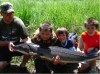
Paddlefish inspires military


The U.S. Army Corps of Engineers is studying the microscopic anatomy of the paddlefish for possible military applications, like better armor, ship design and sensor arrays. The fish, which is native to many Great Lakes states, has a long nose-like feature called a rostrum that detects the weak electric fields of tiny zooplankton. Its unique skeleton is also made up of star-shaped bones that make it flexible and yet resilient. The study is an example of bio-inspiration, the  examination of  an organism’s adaptations in nature, such as gecko’s feet or a spider’s web, to create similar applications for human use. Army scientists think that the paddlefish’s delicate sense for electricity could be copied to detect metal objects or electrical signals from explosives.

Coastal comparison


The Great Lakes coastline is one of the longest in the United States, according to the National Oceanic and Atmospheric Administration. The federal agency compared the total miles of Great Lakes coastline with the total miles of the Atlantic, Pacific and Gulf coastlines. Here’s how it stacks up against the Atlantic coastal states:

Here’s how the Great Lakes coasts stack up against the Pacific coast states. If it wasn’t for Alaska, the Great Lakes coastline would dominate these states:

And it’s not even a contest when compared to the Gulf Coast states:

More information can be found at the agency’s Great Lakes Environmental Research Laboratory website. The laboratory researches the environment to provide information about resource use and sustainability of Great Lakes ecosystems.
 

Mr. Great Lakes: Weeds, water bottles and the “Mega List”

 
Mr. Great Lakes (Jeff Kart) reports from Bay City, Michigan’s Delta College Q-90.1 FM.  


This week Kart discusses phragmites in the Saginaw Bay watershed, efforts at Central Michigan University to reduce water bottle sales and an environmental priority list for the Au Sable River. Text at Mr Great Lakes

Where’s the Concern? Week 10

Each week, Great Lakes Echo features a photo story about a different Area of Concern designated by the U.S. or Canadian governments in the Great Lakes basin. Guess where the area is located, based on the description of the site.

Photo Friday: Frozen lighthouses

[cincopa AwDASLbegkNo]

Tom Gill, an environmental photographer, has a soft spot for frozen lighthouses. The slideshow above showcases photos of the St. Joseph Pier Lighthouse and the South Haven South Pier Lighthouse, which become coated in ice after Lake Michigan waves crash and freeze. More can be found on Gill’s Flickr and blog. Gill’s icy Lake Michigan lighthouse photos have been published in the Huffington Post, Australia News Limited and the Daily Mail in Great Britain. “Only 4 more continents to go,” Gill joked.

Great Lakes to receive $19 million for Hurricane Sandy damage

It’s been almost five months since Hurricane Sandy unleashed destruction in the eastern United States, but the recovery for the Great Lakes region is just getting started. Jo-Ellen Darcy, the Assistant Secretary of the Army, confirmed that the Great Lakes region would receive approximately $19 million. A group of Midwest senators wrote to the U.S. Army Corps of Engineers in February, petitioning for federal aid to repair Great Lakes ports, harbors and waterways damaged by the hurricane. “While the Great Lakes navigation system is threatened due to underfunding, which has been worsened due to lakes levels that have hit record lows, the system also was damaged by Hurricane Sandy,” the letter read. Michigan Sen. Carl Levin led the efforts, petitioning to Senate Appropriations Chairman Barbara Mikulski for Great Lakes recovery projects.

Anti-fracking group gears up for ballot fight

Some environmental advocates criticize hydraulic fracturing, including the Committee to Ban Fracking in Michigan, which is gearing for its second push to prohibit new horizontal fracking.

Despite what industry officials call an impressive safety track record, this method of natural gas extraction is under fire.