Video: How to prevent sickness from blue-green algae blooms


A Wisconsin agency recently released this video explaining how people and pets can avoid getting sick from blue-green algae. Blooms of blue-green algae are a health concern among inland lake beach-goers in the Great Lakes region. This summer’s record heat could increase the risk. “Reports of blue-green algae blooms in June and July were worse this year than they were last year,” said Emmy Wollenburg, outreach specialist at the Wisconsin Department of Health Services. August is usually the heaviest month for the algae, but the heat is making blooms pop up much earlier, Wollenburg said.


U.S. and Canadian warships tour the Great Lakes

U.S. and Canadian warships are touring the Great Lakes to demonstrate unity on the bicentennial of the War of 1812. The U.S. and British Canada were on opposing sides of that war, sometimes called the Second War of Independence. Canadian vessels are also demonstrating their power and role in protecting the region. HMCS ships Ville de Québec, Moncton and Summerside will be joined by the American vessels USS Hurricane and USS De Wert, according to a news release by the Royal Canadian Navy. Events include band concerts, Blue Angels air shows, cook-offs, demonstrations of the U.S. Marine Corps, and other activities

Destination schedule and featured ships:

Milwaukee, Wis., Aug.

Three nature nerds are “Lookin’ at It”


Three self-proclaimed nature nerds from Buffalo, N.Y., are on a mission to use comedy to inform the world about nature. Matt Candeias, Steve Fleck and Jason Mazurowski recently published episode five of their humorously enlightening ode to ecology, “Lookin’ at It: A Nature Show.” It features the Great Blue Heron, the largest heron in North America.  Not only did I laugh out loud, I learned that they are one of few heron species that stab through their prey before eating it. The Lookin’ at It crew uses a comedic platform to highlight the greater Buffalo region’s beauty while educating their viewers about the importance of conservation. While some episodes are sillier than others, the marrying of comedy to nature seems to be working. “Anytime someone talks about an ecological issue, it usually comes around to something about polar bears or the deforestation of the rainforest,” Candeias says in the first episode of the show.

Digital artists create animated wind map

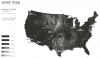
Photo: Hint.fm. Two digital artists recently released an animated map illustrating the speed and direction of surface winds across the U.S.

It’s ever changing patterns are driven by wind data from the National Digital Forecast Database kept by the National Oceanic and Atmospheric Administration. The database also feeds information to the administration’s Great Lakes current map released last month to help the public better understand lake currents. Unlike the water current map, the wind map is not affiliated with the federal agency. Visual collaborators Fernanda Viégas and Martin Wattenberg warn the data is not reliable and that no one shouldn’t use it “…to fly a plane, sail a boat or fight wildfires.”

They refer to the wind map as a personal art project.

Michigan lake named America’s second best; it isn’t Great

Michigan’s Lake Charlevoix is America’s second best lake, according to a USAToday poll. And it’s not even a Great one. Actually, the five Great Lakes were exempt from the contest that was meant to “spotlight some of the USA’s smaller, less famous summer getaways.”

Hmmm…then how did a hotspot like Lake Tahoe garner first? Editors of five regional travel magazines were each asked to nominate three lakes for readers to vote on. Here’s what Midwest Living’s Kendra Williams said in her nomination of Lake Charlevoix: “Just east of Lake Michigan, inland Lake Charlevoix offers an idyllic getaway with Boyne City as its artsy, laid-back anchor.

Lake Ontario glints at spacecam

Sun glints off the surface of Lake Ontario in the lower right corner of this image taken recently by astronauts on board the International Space Station. The mirror-like effect is known appropriately as sunglint. NASA’s Earth Observatory reports the picture was taken when the station was over southeast Nova Scotia and about 740 miles from the centerpoint of the image. From this perspective you can see Lake Huron’s Saginaw and Georgian bays above and to the right of Lake Ontario, and the Finger Lakes of New York to its left. Sunglint also highlights Lake Erie to the west, but the angle makes it appear duller than Lake Ontario.

Hot times for a cold lake; Lake Superior headed for record temp


The coldest of the Great Lakes may be headed toward record warmth. Lake Superior is already the warmest it’s been at this time of year in at least a century, according to Climate Central,a group that researches and reports on climate. The group recently reported that Lake Superior began warming earlier than normal because of scant lake ice cover and an unusual March heat wave. Warm temperatures since have kept the heat on. The analysis is based on data from researchers at the Great Lakes Environmental Research Laboratory and the University of Minnesota-Duluth.