People stand along a fence, fishing at Spring Valley Trout Farm

How inland fish farmers cultivate a sustainable future for the Great Lakes 

By Donté Smith 

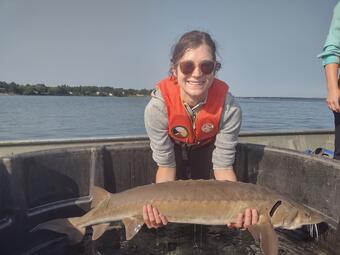
Despite being surrounded by the largest group of freshwater lakes on Earth, Michigan imports the vast majority of its seafood, between 65% and 90%, according to Michigan Sea Grant. As global aquaculture has grown to meet increasing demand for protein, a small but determined group of inland fish farmers in the Great Lakes region are building a more sustainable, local supply. Researchers say doing so could ease pressure on wild populations, create jobs in rural areas and help restore public trust in the food on their plates. But with high regulatory costs, limited consumer awareness and strong competition from imports, these farms face an uphill swim.

Outdoor Discovery Center staffer digs in the dirt in a field. She is next to a shovel and bucket.

Small city’s ‘community carbon fund’ promises hyper-local carbon reduction

By Emilio Perez Ibarguen

In 2023, community organizers from the outdoor Discovery Center, an outdoor education and conservation-focused nonprofit in Holland, Michigan looked for ways to further sustainability efforts in the west Michigan community. This led to a partnership with another local nonprofit to create the Carbon Community Fund, which accepts donations from residents to fund local conservation efforts.

The Hammond Bay Biological Station

Trump’s budget would devastate sea lamprey control in Great Lakes

By Maya Moore 
If Congress approves President Donald Trump’s proposal to cut hundreds of millions of dollars from the operations and science budget of the U.S. Geological Survey, the scale and intensity of Great Lakes environmental restoration will be significantly diminished, experts say.   Among the programs that could be dismantled entirely is the 70-year-old program to control sea lampreys, an exotic parasitic fish that attacks game fish and has caused billions of dollars in damage to Great Lakes fisheries.

Pupae covered with panty hose and labeled with colorful clips

John Ball Zoo Fights for Great Lakes’ Rarest Butterflies

By Donté Smith 
Butterfly populations are in decline across the continental U.S., dropping by 22% between 2000 and 2020 according to a study in the journal Science. Almost a third of the 342 species studied have seen their numbers fall by more than half.  To help combat that trend, the John Ball Zoo in Grand Rapids, Michigan, launched its Great Lakes Rare Butterfly Program in 2021 to protect the region’s most threatened species.