Catch of the Day

Sep 2 2010 | Haley Walker | 3 Comments

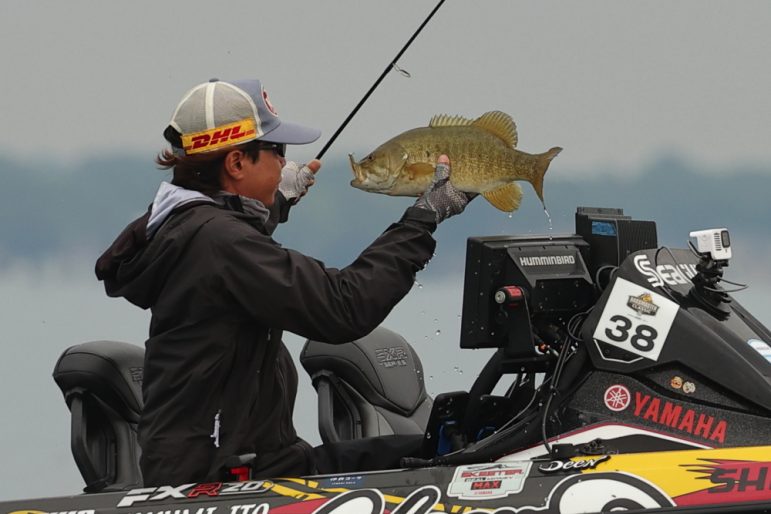
In a section of the New York Times called “Room for Debate,” I recently found a discussion about the fishing practice “catch and release.” The online section invites different experts to debate current events and topics. This particular one was prompted by the headline “Catching but Not Releasing” and followed by the questions “Do fish feel pain?’ and “Should invasive species be thrown on the grill?”
I suppose after writing about Great Lakes issues for the past year, my eye is trained to read and look for stories about invasive species. …

Aug 27 2010 | Rachael Gleason | No Comments

Planes outfitted with lasers have been probing the depths of Lake Superior for the past two months.
Their mission? Measure lake bottom elevations along the coast using a laser surveying technique called LIDAR, or Light Detection and Ranging.
The process is similar to how bats and dolphins use sound waves to judge distances. The planes shoot lasers into the water and measure how long it takes for the pulses to hit lake bottom and return; time indicates water depth.
It’s difficult for research vessels to navigate shallow waters to measure depths along the …

Aug 20 2010 | Jeff Gillies | No Comments
Storms in 2008 flooded Wisconsin's Lake Delton and destroyed homes. Storms this year closed Milwaukee streets and flooded basements. Climatologits say climate change could make these storms more intense and frequent. Photo: U.S. Air Force.

Mike Nichols doesn’t take a position on global climate change. He just writes newspaper editorials downplaying its effects.
Nichols, a senior fellow with the free-market think tank Wisconsin Policy Research Institute, took exception in a recent column to the term “climate chaos,” which has gotten a lot of media play as floods drown Pakistan and a heat wave bakes Russia.
In a recent article in the New York Times, reporter Justin Gillis describes the connection between chaotic weather and greenhouse gasses:
“Theory suggests that a world warming up because of those gases will …

Jul 30 2010 | Jeff Gillies | One Comment
Photo: Michigan State Police

Amid the media frenzy following the 800,000-gallon oil spill in the Kalamazoo River, some confusion is brewing over how much oil that is.
Specifically, just how deep it would bury a football field.
Reporter Tim Martin tried to contextualize the big spill this way Wednesday in an Associated Press article:
“An 800,000 gallon spill would be enough to fill 1-gallon jugs lined side by side for nearly 70 miles. It also could fill a wall-in football field including the end zones with a 14-foot-high pool of oil.”
News outlets from Indiana to Los Angeles …

Jul 28 2010 | Michigan NOW | 3 Comments

Listen to the story…

The oil spill in the Kalamazoo River is entering its third day. It started when a transcontinental pipeline ruptured near the town of Marshall. Governor Granholm was on site yesterday. And President Obama has pledged support. At least 19,500 barrels have flowed into the river and to the City of Kalamazoo. The story from Chris McCarus with Michigan Now:
People parked their cars next to 15 Mile Road bridge. It’s just west of the City of Marshall. Swift current carried black and blue plumes along the surface of …

Jul 27 2010 | Jeff Gillies | No Comments

Recently, five Great Lakes states sued the Metropolitan Water Reclamation District of Greater Chicago and the U.S. Corps of Engineers over the Asian carp issue.
But, shortly after that, a group of Great Lakes leaders — including Chicago Mayor Richard Daley — announced a plan to collaborate on a $2 million study to determine the best way to keep invasive species from moving between the Great Lakes and the Mississippi River basins.
It’s a scientific fact that nothing angers up the blood of Asian carp more than interstate cooperation. So it’s no …

Jul 21 2010 | Jeff Gillies | One Comment
Decreasing ice cover and higher winds are likely contributing to Lake Superior's rapid warming. Photo: NOAA

Lake Superior has a fever, and the only prescription is a pile of media coverage.
The coldest Great Lake is around 15 degrees warmer than usual for this time of year and on track to beat its record high temperature of 68 degrees, reports ClimateWire’s Dina Fine Maron in the New York Times.
Over at the Great Lakes Town Hall, blogger Dave Dempsey recently pointed to a report on climate change in Lake Superior from the University of Minnesota Duluth’s Large Lakes Observatory.
The report (PDF) cites research findings that Lake Superior’s surface …

Jul 20 2010 | Jeff Gillies | One Comment
The trails of the Sleeping Bear Dunes offer fair views of Lake Michigan

Get outside and do it simply, Detroit Free Press outdoor writer Eric Sharp urges in this article on hiking trails of the Pinckney and Waterloo state recreation areas.
Hiking is a great way to get some exercise and tune into nature without spending hundreds on a bike or boat. That’s not to say that I couldn’t sink a few pay checks into ultralight tents, packs, sleeping bags and camp cookware systems. But all you really need are some shoes and a trail.
Sharp profiles some the 2- to 30-mile trails in the …

Jul 13 2010 | Rachael Gleason | One Comment
The oil spill could halt a slow recovery of the Great Lakes piping plover, but it will take time to fully understand the spill's impacts on migratory birds. Photo: auburnxc

Last month Echo reported that Great Lakes migratory birds are threatened by the Gulf oil spill.
Regional bird expert Francie Cuthbert, a University of Minnesota professor, was busy with fieldwork when we tried to reach her then. But she got back with us for this update:
Female Great Lakes piping plovers will head south for the winter ahead of the males in a couple weeks. Since nothing is cleaned up, they will almost certainly be affected by the spill, Cuthbert says.
She expects only a small percentage of plovers that come in contact …

Jul 8 2010 | Guest Columnist | One Comment

Ah, July in the Great Lakes region, kicking off with Canada Day/Fête du Canada, followed by a quick segue into Independence Day, and then a blur of festivals, picnics, barbecues, mosquitoes, raspberry and cherry season, county fairs, beaches and boats, lemonade, and maybe baseball on the radio. We squeeze a lot into these rare weeks of precious Midwestern summer, which is why carving out time to get substantive comments into the US-Canada Great Lakes Water Quality Agreement negotiating team by July 9 seems even harder than a deadline in say, …