Wildlife

Illinois pols won’t back separation; environmental groups whiff on carp report
|
Opportunities of this magnitude to protect the Great Lakes are rare and don’t last forever.
Great Lakes Echo (https://greatlakesecho.org/tag/commentary/page/16/)
Opinion and commentary about Great Lakes issues.
Opportunities of this magnitude to protect the Great Lakes are rare and don’t last forever.

Ask natural scientists why small parks matter and you’ll hear about habitats, biodiversity, carbon sequestration and buffer zones between developments. Ask the same question to social scientists and you’ll hear about maintaining human connections with nature, centers of community concern, neighborhood identity and healthy outdoor activities. Small parks can even serve a public policy purpose as a political rallying point. That happened last year in Turkey when government plans to develop 9-acre Taksim Gezi Park — one of Istanbul’s smallest parks and among the few remaining green spaces in the city’s BeyoÄŸlu district— triggered sit-ins and national demonstrations. From a humanist as well as scientific perspective, poet-environmental activist Wendell Berry has written that we need not cherish just the great public wildernesses” but small ones as well.
Great Lakes Echo commentator Gary Wilson looks back at some of the biggest Great Lakes stories of 2013.
How do we talk about water?
Great Lakes water isn’t a Big Mac. Or a Budweiser. Or bottled water.
We need talking points that inspire.

IJC Commissioner Dereth Glance says Great Lakes stewardship is fraught with frustrations and backslides.
But a combination of learning and action can get that Sisyphean boulder further up, if not to the top of the hill.
Gary Wilson takes a look at some of the common myths surrounding the Great Lakes and how they have come to be perceived as realities.

If you had the chance, how would you recreate the United States? John Lavey, a land use planner at the Sonoran Institute, designed this map that divvies up the country by its watersheds. The idea is to use water more efficiently while minimizing conflicts over its use. He gerrymandered state boundaries by Hydrologic Unit Codes, keeping capitals and national borders intact. Not a bad idea.
Those troublesome Asian carp continue to attract national attention — this time starring in an award-winning series of stories in the Milwaukee Journal Sentinel. Reporter Dan Egan recently won the top award given by the American Association for the Advancement of Science in the large newspaper category for science reporting. He was recognized for Deep Trouble, a series looking at the biological, public policy and engineering challenges that the carp pose for the Great Lakes. “The history of engineering, public works, and invasive species battles is woven into the story elegantly,” said Laura Helmuth, science editor for Slate. “It’s a fascinating read, full of drama and passion.”
By Eric Freedman
The more things don’t change…
I’ve been perusing the shelves of the Knight Center’s conference room library, getting rid of–recycling–outdated books to make room for new ones. These, published from the early 1980s through the mid-1990s, are just a sampling of our castaways:
“Footprints on the Planet: A Search for an Environmental Ethic” by Robert Cahn
“Public Policy for Chemicals: National & International Issues” by Sam Gusman, Konrad von Moltke, Francis Irwin & Cynthia Whitehead
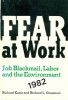
“Fear at Work: Job Blackmail, Labor & the Environment” by Richard Kazis and Richard Grossman
“Radiation & Human Health” by John Gofman
“Renewable Energy: The Power to Choose” by Daniel Deudney & Christopher Flavin
“Environmental Regulation and Economic Efficiency” by the Congressional Budget Office
“Crossroads: Environmental Priorities for the Future” by Peter Borelli
“International Environmental Policy: Emergence & Dimensions” by Lynton Caldwell
“Global Warning: The Economic Stakes” by William Cline
“How Many Americans? Population, Immigration & the Environment by Leon Bouvier & Lindsey Grant
Although their content may be stale–often by decades–what struck me was how the same issues remain prominently in today’s headlines: Alternative energy. Population. Climate change.

By Eric Freedman
Commentary
It’s not the grandeur of ice-encrusted Lake Superior in winter or Lake Michigan under a setting summer sun. It’s not the pristine early morning glisten of the Au Sable River. It’s not the sailboat-plying juncture of the St. Clair River and Lake Huron beneath the shadow of the Blue Water Bridge. It’s not the Straits of Mackinac, Houghton Lake, the Soo Locks.