Green gavel: Illinois man loses appeal in asbestos case

By Eric FreedmanGreat Lakes EchoA federal appeals court has upheld a 10-year prison term for an Illinois sprinkler contractor who hired untrained workers to illegally remove asbestos without protective equipment and then arranged to dump the contaminated material. Prosecutors presented sufficient evidence to the jury that Duane “Butch” O’Malley knowingly violated the Clean Air Act by removing, transporting and dumping insulation containing asbestos, the U.S. 7th Circuit Court of Appeals unanimously ruled. Researchers have linked asbestos to such serious health risks as asbestosis, nonmalignant lung disorders, lung cancer and mesothelioma. According to legal documents, real estate developer Michael Pinski bought a Kankakee, Ill., warehouse that contained asbestos-containing insulationwrapped around pipes. Kankakee is about 60 miles south of Chicago.

Why Small Parks Matter

Ask natural scientists why small parks matter and you’ll hear about habitats, biodiversity, carbon sequestration and buffer zones between developments. Ask the same question to social scientists and you’ll hear about maintaining human connections with nature, centers of community concern, neighborhood identity and healthy outdoor activities. Small parks can even serve a public policy purpose as a political rallying point. That happened last year in Turkey when government plans to develop 9-acre Taksim Gezi Park — one of Istanbul’s smallest parks and among the few remaining green spaces in the city’s BeyoÄŸlu district— triggered sit-ins and national demonstrations. From a humanist as well as scientific perspective, poet-environmental activist Wendell Berry has written that we need not cherish just the great public wildernesses” but small ones as well.

Homeowners lose chemical contamination appeal

Homeowners whose property was contaminated by materials from a now-defunct chemical plant in Michigan’s Gratiot County have lost their lawsuit against contractors and trucking companies that removed toxic sediments from the adjacent Pine River.

What’s on your bookshelf?

By Eric Freedman

The more things don’t change…

I’ve been perusing the shelves of the Knight Center’s conference room library, getting rid of–recycling–outdated books to make room for new ones. These, published from the early 1980s through the mid-1990s, are just a sampling of our castaways:

“Footprints on the Planet: A Search for an Environmental Ethic” by Robert Cahn
“Public Policy for Chemicals: National & International Issues” by Sam Gusman, Konrad von Moltke, Francis Irwin & Cynthia Whitehead
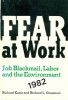
“Fear at Work: Job Blackmail, Labor & the Environment” by Richard Kazis and Richard Grossman
“Radiation & Human Health” by John Gofman
“Renewable Energy: The Power to Choose” by Daniel Deudney & Christopher Flavin
“Environmental Regulation and Economic Efficiency” by the Congressional Budget Office
“Crossroads: Environmental Priorities for the Future” by Peter Borelli
“International Environmental Policy: Emergence & Dimensions” by Lynton Caldwell
“Global Warning: The Economic Stakes” by William Cline
“How Many Americans? Population, Immigration & the Environment by Leon Bouvier & Lindsey Grant

Although their content may be stale–often by decades–what struck me was how the same issues remain prominently in today’s headlines: Alternative energy. Population. Climate change.

Bigfoot, dams and environmental newsworthiness

By Eric Freedman

When I turned on my laptop shortly after 6:15 a.m. on Friday, there was a breaking news story on my CNN homepage about Tropical Storm Karen threatening the Gulf Coast. The homepage also had links to these other environment-related and science-related stories: “Deadly hornets are world’s largest,” “Roman skulls unearthed in London” and “Dinosaur’s fossilized tail found,” plus video links to “Great white sharks munch on whale” and “Does this video show a snoozing Bigfoot?” You may debate whether Bigfoot, a/k/a Sasquatch, counts as a topic of science rather than of myth, imagination or delusion, but science is one of the options, unlikely as that might sound. It was the start of my second day at the annual conference of the Society of Environmental Journalists in Chattanooga, and an indication of what’s on the minds of environmental journalists as newsworthy these days. Beyond natural disasters, dinosaurs, ancient civilizations, homicidal insects, ravaging fish and legendary creatures–all obviously on the minds of CNN’s journalists–the SEJ conference programhighlights other issues that regularly make the headlines: Climate change, of course. Fracking, unsurprisingly.