Americans want more and better environmental reporting; help us get some

Advocating for improved reporting on the environment is central to my job at Michigan State University’s Knight Center for Environmental Journalism. But apparently most of you agree that it’s a good idea. In fact, nearly 80 percent of Americans believe news coverage of the environment should be improved, according to a national poll commissioned by the Project for Improved Environmental Coverage. The Opinion Research Corp. conducted the poll April 14-15.

Environmental literacy: What should every Great Lakes citizen know?

What’s the minimum every responsible citizen of the Great Lakes region should know about their environment? It’s a question we’ve been noodling recently in the Echo newsroom. The idea is to develop a list and use it as the basis for questions we’ll ask random people – sort of like the Jaywalking feature on the Tonight Show. We’ll video their answers – right, wrong, funny, creative – and conclude with a look at the answer. We’re consulting some environmental educators and advocates on the kinds of things we might ask.

Can you make trees dance? Create wonder from water?

Love water? Sitting in a basin containing 20 percent of the world’s fresh surface supply of the stuff will do that to you. That’s why we think someone from the Echo news community should win this year’s EPA Rachel Carson Sense of Wonder contest. This is a photo, essay, poetry and dance contest. Teams consist of two or more people – at least one younger, one older.  The idea is not only cross generational, but multi-organism.

Environmental portraits at the birth of the EPA

I was pretty excited when a few years back Jeremy Herliczek, a photographer and a graduate student at Michigan State University, offered to create a portal to a little known gem of the Environmental Protection Agency. Called Documerica, the EPA project attempted to document the state of the environment at the birth of that agency. The trouble is that accessing those old environmental images is difficult. So, too, is simply sorting through them. Jeremy’s project for his masters thesis was to create galleries of some of the best images, explain the history of the project and also explain how to manipulate the ponderous system for retrieving them. MSU’s Knight Center for Environmental Journalism – which produces Great Lakes Echo – sponsored his research and hosts that effort.  Take a look.

Echo reporter hits the air waves

Here at Echo we are always happy to see others use our content, provided it is properly credited. It’s especially nice when it jumps mediums.

Reporter Brian Bienkowski experienced that kind of shift recently when WILS radio interviewed him about his recent Echo story about Michigan authorizing the use of an unregistered pesticide to battle an apple tree blight. The disease is growing resistant to current treatments. The Echo version attracted a fair number of comments. It’s a fine story, but I’m always surprised by which ones generate comment and attention.

Former Echo reporter recognized for environmental video production

Matt Cimitile, the first reporter at Great Lakes Echo, recently won national recognition for a series of environmental videos. Matt is a 2009 graduate of the masters program at Michigan State University’s Knight Center for Environmental Journalism.  He is now a writer and multimedia specialist for the United States Geological Survey. He writes, lectures and otherwise communicates about science and environmental issues researched at that agency’s Coastal and Marine Science Center in St. Petersburg, Fla.

It takes a community to build a newsshed

By David Poulson

Last week the Healing Our Waters coalition recognized Echo for excellence in reporting on the Great Lakes. We’ve been recognized by others for pioneering some unusual forms of journalism. But I like to think that this Great Laker award recognizes our success with a traditional function of news: Defining, creating, organizing and fostering community. Journalists most often define news communities as towns, cities, provinces, states and even nations.  The Echo experiment defines a news community in relationship to a natural resource. The concept is that a watershed is more than a hydrologic feature.

Region provides fodder for fine environmental journalists

The Great Lakes region was nicely bookended recently with recognition by the Society of Environmental Journalists of some of North America’s finest environmental reporting

The organization recognized Michael Hawthorne of the Chicago Tribune and Michelle Lalonde of the Montreal Gazette as outstanding environmental reporters. Both won second place for beat reporting in their publications’ circulation size. Beat reporting is one tough category. You have to be a committed, aggressive reporter and a skillful writer. Perhaps the hardest part is that you need to be consistently good at covering diverse environmental issues.

Upending the basin (and animating it, too)

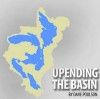
That little animation you just saw to the left of this text is pretty cool for a couple of reasons. The first is for what it does rather simply. The Upending the Basin logo is meant to communicate Echo’s desire to explore journalism and the Great Lakes environment from nontraditional points of view. But it is surprising how few people  recognize the Great Lakes basin when you stand a static image on its ear like this. Lifelong Michigan residents are baffled when they see their state’s mitten in anything but an  upright position.