Echo
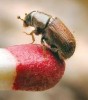
Climate change opens door to forest pests new to Great Lakes
|
As climate changes and growing seasons are interrupted by drought and frost, trees become more vulnerable to insects and disease.
Great Lakes Echo (https://greatlakesecho.org/author/admin/page/13/)
As climate changes and growing seasons are interrupted by drought and frost, trees become more vulnerable to insects and disease.
When people think of Michigan’s economy, they typically point to the State’s automobile industry or its agricultural sector. Often overlooked is one of Michigan’s greatest natural assets: water. A new report commissioned by the governor’s office focuses on accelerating Michigan’s water based or ‘Blue economy.’ The paper’s author, John Austin, is the Director of the Michigan Economic Center at Prima Civitas Foundation. Austin says that a ‘Blue Economy’ is similar to a ‘Green Economy.’ Michigan economic developers eye ‘Blue Economy’ by Great Lakes Echo
In 2008, the state legislature passed Michigan’s Renewable Portfolio Standard. The law requires that by the year 2015, utilities must generate at least 10 percent of their energy from renewable sources. As 2015 approaches, state officials are working to determine the next steps for Michigan’s energy policy.
Achieving nuclear fusion has proven to be elusive for generations of scientists. According to the BBC, American scientists have brought us one step closer to nuclear fusion becoming a viable source of clean energy.

The locavore movement has taken off in the last five years at least. This notion that consuming food that is raised and grown close to where we live was even given a memorable send-up in the hit IFC comedy “Portlandia.” But parody is not the only thing the locavore movement has spawned. Over the last five years, food hubs have become an increasingly popular way to scale the local food movement affordably and efficiently.
According to the Pew Clean Energy Program, global energy consumption is expected to increase 35% over the next 25 years, with much of that from growing electricity use and expanding vehicle fleets. Phyllis Cuttino is director of the Pew Charitable Trusts’ Clean Energy Program. She addresses energy consumption in relation to clean energy. Energy by Great Lakes Echo
According to a new report by the Organization for Economic Co-operation and Development, 40 percent of the world’s population will live under severe water stress by 2050. While the Great Lakes region is water rich, the report suggest that even water wealthy areas should work toward adaptive policies to secure freshwater’s future.
Ontario Power Generation plans to store radioactive waste in an underground cavern near Lake Huron.
The storage site’s proximity to the lake has raised concern across the Great Lakes basin.
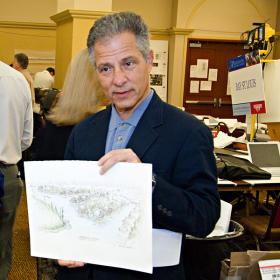
Architect-futurist: Think locally, act locally by Great Lakes Echo
For more than 30-years, Andrés Duany has sought to end suburban sprawl and urban disinvestment, both in American cities and around the world. Duany is credited with advancing the design aesthetic known as “New Urbanism.” The New Urbansim movement urges people to move beyond 20th century thinking, focusing on ideas that don’t cost money. Another important aspect of Duany’s aesthetic is climate change. He says that there is no evidence that the world will “beat” climate change and because of this western society will enter into a period of demoralization. Duany believes the way to avoid this depressing state is to act locally.

This summer a coalition of Detroit based organization released the Detroit Environmental Agenda. The two-year project addresses improving quality of life through improving the environment. Guy Williams, President of Detroiters Working for Environmental Justice joins Current State to discuss the report his organization helped compile. Tackling environmental issues crucial for Detroit’s success by Great Lakes Echo