By Isabella Figueroa Nogueira
The farmland she grew up with lies wide under a Minnesota sky. The rows of corn and prairie grass stretch endlessly, telling stories of family and hard work.
When Margret McCue-Enser returned to her family’s home, she realized the land her family had tended for five generations carried other stories, ones she’d never been taught.
“I wanted to understand the story of the land, like our home, like my hometown and where I live now, which isn’t too far away,” said McCue-Enser, a professor of communications at St. Catherine University in St. Paul.
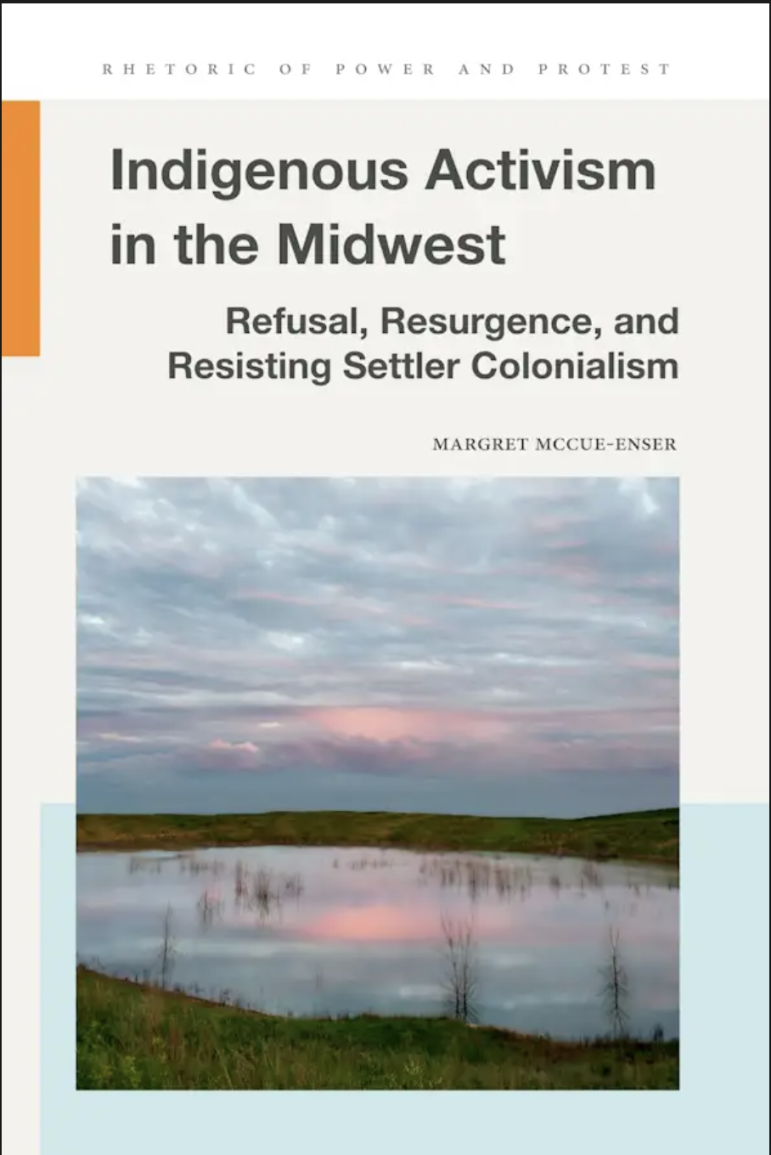
That curiosity became the foundation for her book, “Indigenous Activism in the Midwest: Refusal, Resurgence and Resisting Settler Colonialism” (Michigan State University Press, $34.95).
The book explores how Dakota and Anishinaabe communities in Minnesota continue their relationships to the land and challenge dominant settler narratives about ownership, belonging and identity.
“Once you do that, if you haven’t already, you recognize that not only do Indigenous nations continue to have a relationship with land, but that place, that land is central to everything,” McCue-Enser said. “And it’s a very different way of thinking about and relating to land than I had come to learn.”

Growing up in a small rural town in southwestern Minnesota called Belle Plaine, she was surrounded by farming traditions.
“The Grange movement started here, literally kind of in my backyard,” she said, referring to the national farmers’ organization founded in the 1860s that brought together rural communities to share resources and push for agricultural and social improvements.
“But it’s also and always has been a Dakota and Anishinaabe place. And I worry that we as a collective, as a community, as a state don’t recognize that,” she said.
McCue-Enser’s academic path shaped her approach to this research. After studying at the University of Iowa, she shifted from traditional rhetorical theory to exploring how communication exists in physical and cultural spaces.
One of the book’s focuses is “refusal,” a concept central to Indigenous activism that she defines as asserting identity and sovereignty on one’s own terms.
She said, “Refusal is insisting on using your own terms that define you in terms of recognition.”
That principle guided her interpretation of sites like Fort Snelling, where signs honor Dakota heritage while avoiding fixed timelines, leaving space for Indigenous continuity.
Fort Selling is a national historic site in St. Paul. It sits atop the bluffs overlooking the confluence of the Mississippi and Minnesota rivers.
As both a scholar and a Minnesotan, McCue-Enser said she hopes her work opens space for readers to reconsider what land means, not just as an economic resource, but as a connection between people and a place.
“If farmer descendants and settler descendants have such a reverence and appreciation for home and for land, and yet we know that land is a commodity, land is traded and exchanged as a matter of economic survival,” she said, “can’t we then – just for a second – consider what it is if that land is not only our means of economic survival and our family story, but our very being?”