By Eric Freedman
The Michigan Court of Appeals has cleared the city of South Haven of liability in the 2020 drowning of an 18-year-old swimmer at a public beach on the Lake Michigan coast.
By a 2-1 vote, the court dismissed the wrongful death suit filed by Brandon Chambers’s estate. It accused the city of negligence and premises liability for failing to post high-risk red warning flags at the section of South Beach where the accident occurred.
Chambers, from Jackson County, was swimming at an area marked by yellow flags, struggled, and went under the surface “due to dangerous wave conditions/rip currents,” the estate said in its court brief. No lifeguards were on duty there.
The suit alleged that the city ignored National Weather Service warnings about dangerous swimming conditions and didn’t mark that stretch of beach with red flags.
Yellow flags signal “Medium hazard. Moderate surf and/or currents are present. Weak swimmers are discouraged from entering the water. For others, enhanced care and caution should be exercised,” according to the U.S. Lifesaving Association. More severe conditions are indicated by red and double red flags.
In general, public bodies in Michigan are immune from negligence claims when carrying out governmental functions. However, there is an exception for so-called proprietary — or profit-seeking — activities.
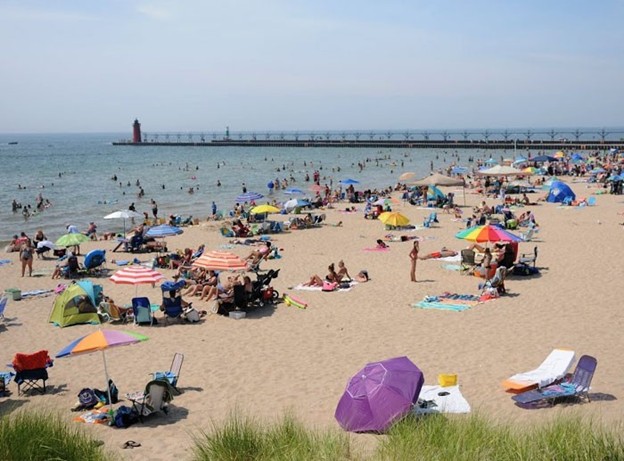
The city promotes tourism by boasting of its “treasure trove of beautiful beaches, each with its own unique personality and allure.” South Beach is one of 10 public beaches in the city.
“South Beach stands out as the vibrant heart of the beach scene, bustling with activity and brimming with amenities,” with its “white sandy beaches, clear swimming areas” and the Big Red Lighthouse, making it “a hub of summer fun and relaxation.”
In court, the estate argued that the city isn’t shielded from responsibility for Chambers’ death because it uses some of its beach funds for other city purposes.
Thomas Beindit, a Lansing lawyer representing South Haven, said, “We don’t charge or collect user fees at beaches or parks. We do charge for parking.”

The city’s legal position was that operating its beaches is a government function because it is self-sustaining, and the principal purpose is not to create a profit, the decision said.
Beindit said, “We appreciate the Court of Appeal’s ruling on this matter.”
Earlier, a Van Buren County Circuit Court judge allowed the estate’s case to proceed toward trial.
The Court of Appeals reversed that decision.
The majority opinion cited testimony from the city’s finance director and tax assessor that South Haven’s beaches consistently earned a profit between 2017 and 2021 but that all the revenue was used for beach purposes.
There was evidence that the city had net revenue of $221,028 from beach and park services for the 12 months ending June 30, 2020.
Even so, the majority found sufficient evidence that the beaches aren’t “operated for the primary purpose of generating a profit.”
In a dissent, Judge Sima Patel pointed to testimony and financial documents that suggested some beach revenue was spent for non-beach purposes, such as motor pool expenses, police services and administration fees. She cited “arbitrary figures” in the financial records and a city official’s inability to explain how the city calculated some fees.
Patel said a trial should determine if the city’s operation of the beaches is intended mostly to “produce a pecuniary profit,” and, if so, whether South Haven is liable for Chambers’s death.
The estate will ask the Michigan Supreme Court to review the case, according to its lawyer, Ronald Marienfeld II of Jackson.
Marienfeld said a similar case against the city is in the appeals process. It arises from the 2022 drowning deaths of college student Emily MacDonald, 19, and recent college graduate Kory Ernster, 22, at South Beach.
That suit contends that water conditions were more dangerous than indicated by the posted yellow flags and that no lifeguards were present.
Marienfeld said, “We’re going to see what the Supreme Court is going to say.”
Chris Johnson, the general counsel of the Michigan Municipal League, said the decision is good news for local governments. The organization represents cities and villages across the state.
“The idea of governmental immunity is to allow communities and employees of communities to act without worrying are they going to get sued,” Johnson said. “It allows governmental employees to act when they need to.
“It protects taxpayers in that respect,” he said.