By Emilio Perez Ibarguen
In 2023, community organizers from the Outdoor Discovery Center Network, an outdoor education and conservation-focused nonprofit in Holland, Michigan had a problem.
Environmentally conscious residents in their west Michigan community were running out of ways to further cut down on their emissions. Some already ate less meat to avoid contributing to emission-heavy animal agriculture or paid a premium to receive renewable energy from their utilities.
Maya Klanderman, a sustainability specialist at the Discovery Center, recalled a common question from residents around that time: “OK, I’ve done all these things. Now, what do I do next?”
That question led to the Discovery Center partnering with another local nonprofit to create the Carbon Community Fund.
Launched in partnership with the Community Foundation of the Holland/Zeeland Area, the carbon fund accepts donations from residents and uses those donations to fund local conservation efforts such as tree plantings that sequester carbon from the air.
Offsetting the average individual’s annual carbon emissions through the fund costs $850 and cancelling out a round trip from Grand Rapids to Los Angeles costs $25. Driving for a single mile takes 2 cents to cancel out.
It’s a hyper-local alternative to the offset programs hawked by airlines claiming to cancel out the greenhouse gas emissions of travel by funding tree-plantings elsewhere. Those national programs have been criticized for wildly inflating carbon reductions.
A 2022 investigation by the Guardian found 90% of carbon credits — certificates that companies purchase to claim their carbon emissions are being offset — have no measurable benefit for the climate.
Organizers of the Holland-area fund say they avoid such pitfalls because — though the fund isn’t connected to any official carbon market and therefore lacks third-party verification — the fund finances only projects that can scientifically demonstrate carbon reduction potential.
“I think part of the charm is being able to tell community members, ‘Here’s where your funds are going,’” Klanderman said. “You can physically see it with your own eyes.”
Similar local voluntary carbon funds have cropped up in communities across the U.S like in Tallahassee and Sitka, Alaska. Most of the funds, like the one in Holland, are operated by nonprofits.
Meanwhile, environmentalists in the UK are advocating for local governments to act as the conduits between local sustainability projects and companies looking to buy carbon credits.
Since launching in late 2023, the Holland-area fund has raised just over $12,000, according to Colleen Hill, the vice president of development and donor services at the community foundation.
So far, those donations have supported two conservation projects in the area, both on land owned by the Discovery Center.
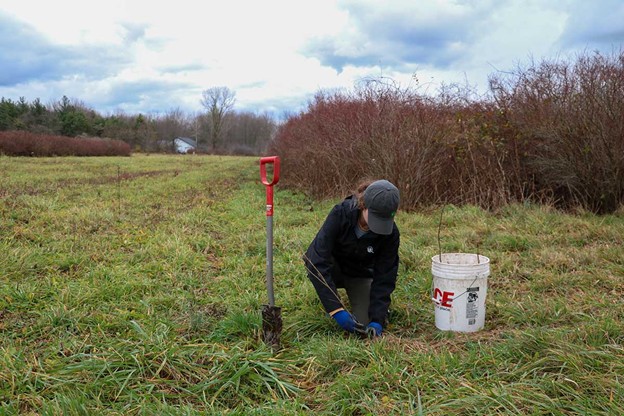
The first project involved planting two acres of native trees on an old airstrip in Holland, projected to sequester 364 metric tons of carbon over the next 40 years.
In November, the Discovery Center planted more than 4,000 native trees on a former blueberry farm. Over the next 40 years, Discovery Center staff estimate, that project will sequester more than 2,734 metric tons of carbon.
So far, the community fund’s total contributions have been small. It supplied $8,000 for the blueberry farm conversion, while the rest of the costs were covered by a $22,000 grant from the state Department of Natural Resources.
“With staff turnover and a couple other projects that popped up, it hasn’t really gotten the attention that I think it deserves,” Klanderman said of the fund.
While the fund’s impact might be small compared to state-funded efforts, Klanderman insisted that residents who donate to the fund are contributing to verifiable reductions in carbon.
Consumers interested in offsetting their carbon footprint have a variety of options at their disposal, but people care about their contribution making a genuine difference, she said.
Tree-planting offset programs used by big companies have been criticized for planting millions of acres of monoculture forests that are susceptible to wildfires, endangering lives and hampering long-term carbon reduction.
In contrast, Klanderman said, the Discovery Center’s projects have emphasized planting native tree species that contribute to the local ecology. The blueberry farm conversion included 12 distinct tree species.
“All of the trees that we use in all of our carbon offsetting projects are native, and we try to have a greater number of biodiversity in those trees in the area to be able to help support local habitats as well as retire carbon credits,” she said.
So far, most donors have been individuals, rather than businesses, Klanderman said. And they’ve tended to be retirees and older people.
However, she said, backers of the fund want to gain traction with more young families and “other types of demographic that go on vacation … that could retire some credits, as well.”
Nonprofits aren’t required by law to disclose their donors, and Hill, of the community foundation, declined to connect Bridge Michigan with donors to the fund.
Success of voluntary offset funds may hinge on the wealth of the surrounding community.
Still, Klanderman says the model has potential, especially if future iterations tap into broader funding sources.
“It’s important to get a broad diversity (of donors), rather than just trying to focus on residents and individuals themselves,” she said.
Emilio Perez Ibarguen has an environmental reporting internship under the MSU Knight Center for Environmental Journalism’s diversity reporting partnership with the Mott News Collaborative in cooperation with Capital News Service. This story was produced for Bridge Michigan.