By Maya Moore
If Congress approves President Donald Trump’s proposal to cut hundreds of millions of dollars from the operations and science budget of the U.S. Geological Survey, the scale and intensity of Great Lakes environmental restoration will be significantly diminished, experts say.
Among the programs that could be dismantled entirely is the 70-year-old program to control sea lampreys, an exotic parasitic fish that attacks game fish and has caused billions of dollars in damage to Great Lakes fisheries.
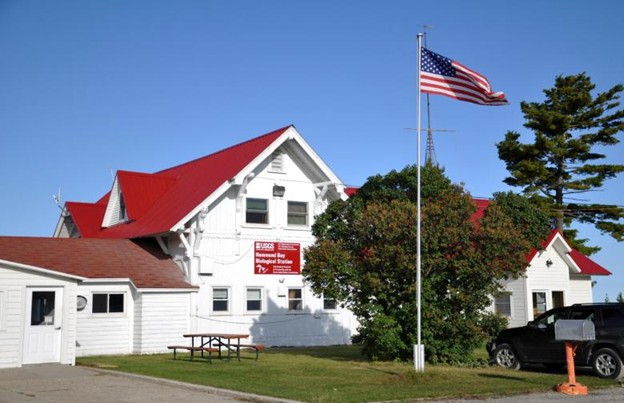
The principal site for lamprey research and control is the agency’s Hammond Bay Biological Station along the shore of Lake Huron.
In partnership with the Great Lakes Fishery Commission, the station’s research focuses on the biology and behavior of sea lampreys and the recovery of native fish populations, while advancing technologies to improve sea lamprey control and fishery management.
Sea lampreys entered the Great Lakes more than a century ago, and over the next half century reduced the lake trout population to 300,000 pounds annually from 15 million pounds. Once- thriving fisheries were devastated, and along with them hundreds of thousands of jobs.
Research and lamprey eradication practices developed at the Hammond Bay Station were central to reversing the collapse.
One noteworthy development was the use of lampricides — chemicals that selectively target sea lamprey without harming most native species. Other advancements include the design of physical barriers and other nonchemical control tools.
Trump’s budget targets the Geological Service’s Ecosystems Mission Area, the principal scientific research center for the Department of the Interior, and a prime source of funds for lamprey control.
Funding for the program could plummet from $293 million in 2025 to just $29 million in 2026, a nearly 90% reduction.
Greg McClinchey, the director of policy and legislative affairs for the Great Lakes Fishery Commission said, “We now know by data that not controlling sea lamprey for as little as five years could mean the collapse of some of these critical fish stocks.”
President Trump’s budget target the USGS Ecosystems Mission Area, the principal scientific research center for the Department of the Interior, and a prime source of funds for lamprey control. Funding for the program could plummet from $293 million in 2025 to just $29 million in 2026, a nearly 90% reduction.
Greg McClinchey, director of policy and legislative affairs for the Great Lakes Fishery Commission said, “we now know by data, that not controlling sea lamprey for as little as five years could mean the collapse of some of these critical fish stocks.”
The Trump Administration has already cut thousands of scientists and field personnel from environmental agencies. His budget proposal calls for the Geological Service to employ 2,650 full-time staff in 2026, a 40% reduction from 2024 when full-time employment was 4,717.
Maya Moore has an environmental reporting internship under the MSU Knight Center
for Environmental Journalism’s diversity reporting partnership with the Mott News
Collaborative and the Mott Foundation. This story was produced for Circle of Blue.