Alewives: Should Great Lakes managers kill ‘em or keep ‘em?

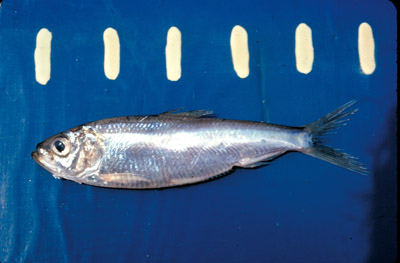
Alewives were once a nuisance non-native species in the Great Lakes. Now they prop up the lakes' hugely profitable salmon fishery. But some experts say they've still got to go. Photo: David Jude
By Jeff Gillies, jeffgillies@gmail.com
Great Lakes Echo
Sept. 2, 2009
Editor’s note: This is the first in a series of stories about the challenges of managing non-native fish in the Great Lakes.
Fishery managers have made little progress in restoring lake trout, the Great Lakes’ dominant predator until the species collapsed in the 1940s and 1950s.
Most of them agree that alewives, a non-native fish, are a big part of the problem. They invaded the lakes from the Atlantic Ocean after the Welland Canal opened in 1932. Alewives eat young lake trout and disrupt chemical processes important to their reproduction.
But biologists don’t plan on getting rid of them now that they’re here. Instead, Lake Michigan managers recently launched fish stocking strategies that protect alewives.
What’s going on?
Invasive species are usually the target of disdain and eradication programs. But alewives get a pass because they’re the main food source for two other non-native species – the chinook and coho salmon. And those salmon are cornerstones of a multi-billion dollar Great Lakes fishery.
Though states imported salmon to control alewives, management plans now serve to keep enough alewives around to keep salmon healthy and abundant.
And as long as state agencies aim to keep available lots of alewives for salmon to eat, lake trout rehabilitation is impossible, said Mark Ebener, an assessment biologist with the Chippewa Ottawa Resources Authority, a regulatory agency representing five Michigan Indian tribes.
Other experts disagree.
Great Lakes fisheries managers have no plans to abandon the profitable salmon fishery, said Marc Gaden, spokesperson for the Great Lakes Fishery Commission.
“There’s no inherent contradiction between managing for the native fishery, and also stocking fish for recreational purposes,” he said. “There is definitely a balance that needs to occur.”
Until the mid 1900s, lake trout were the top predators in every Great Lake but Erie. They supported tribal and commercial fisheries. But a slew of factors drove them nearly extinct in all of the lakes but Superior.
Between overfishing and the invasion of the parasitic sea lamprey that feasted on the fish, the Great Lakes’ annual lake trout harvest plummeted from 15 million pounds to 300,000 pounds by the 1960s.
Great Lakes fishery managers have tried to restore lake trout through sea lamprey control and planting young fish. That’s only worked in Lake Superior where a small lake trout population remained after the species’ basin-wide collapse.
Some researchers think lake trout restoration hasn’t worked because fisheries managers have stocked the wrong age fish in the wrong places at the wrong times.
Others, like Ebener, say the biggest problem is the 6-inch alewife. They exploded by the 1950s and 1960s because there weren’t enough lake trout left to control them. They crowded out native species like white fish and perch, and were prone to huge die-offs that would cover beaches with rotting fish.
In the 1960s, Michigan managers hatched a plan to control alewives by stocking the Great Lakes with chinook and coho salmon, both native to the Pacific Ocean. The salmon would sit in for lake trout at the top of the food chain and draw recreational anglers looking for a fish that fights.
The plan worked, driving down alewives and creating a world-class salmon fishery better than it was in the Pacific where those fish were from, Ebener said.
That built new interest in fishing for other species. Recreational fishing on the Great Lakes was miniscule before the 1960s, Dexter said. There was no Clean Water Act to keep people and industries from freely polluting the lakes, and anglers were happy to stay inland.
“People just didn’t go out there because the lakes were a dumping ground for everybody,” Dexter said. “It was putrid out there.”
But Great Lakes sport fishing grew, bringing a financial boom to sleepy towns that built local economies catering to recreational anglers.
“From guys selling boats to people selling bait to people renting motels, that whole economy developed around salmon,” Ebener said.
Some sports fishermen are worried that state agencies a bias for native species and will pull the plug on salmon, said Dan Thomas, president of the Great Lakes Sports Fishing Council.
“We didn’t create this fishery, they did,” Thomas said. “Now they would take it away from the sportsmen, and the multi-billion dollar economy that it has created,” he said.
Part two: Alewives: The trouble they cause and the salmon that love them.
When you are finished reading this article, please go to the bottom of the page and leave a comment.

The lake trout fishery collapsed here on Lake Champlain, as well, decades before the arrival of the alewife.
Personally, and I have no empirical data to support this assertion, I believe land use patterns in the 19th Century destroyed portions of lake trout spawning habitat and enhanced sea lamprey nursery habitat. This combination may have proven too much for the lake trout. Regardless, something did here on Champlain and it was not a diet of alewives.
Alewives may prove to be the answer to the spiny water flea, one of that devastating creature’s few predators, from what I can gather from European literature. Something to consider.
Sincerely,
LikeJames Ehlers
Executive Director
Lake Champlain International, Inc.
Clean Water. Healthy Fish. Happy People.
http://www.facebook.com/LakeChamplain
http://www.twitter.com/Lake_Champlain
1 person likes this comment
James,
The folks I’ve talked to haven’t blamed alewives so much for the lake trout collapse. That was the sea lamprey and overfishing, though there’s a debate over which one hurt most.
Instead, they say alewives are an obstacle to bringing lake trout back.
Like1 person likes this comment
Fair enough, Jeff, and I apologize if my response implied as much. It was not my intention. I empathize with your situation. There are no easy answers, and they are all interconnected.
I think until we first address the major habitat degradations and encroachments, we will forever be chasing our “tails.” New species naturally move into new habitats, expanding their ranges. The fact that humans have assisted in this migration as opposed to a duck, for example, leaves us with the social consequences with which to contend, such as your local economy now dependent on an exotic fishery. Do we rid all the East of the rainbow trout and all the U.S. of the brown trout? I think we know how the majority might respond to that question. Your situation seems to be much the same.
Sincerely,
LikeJames Ehlers
Executive Director
Lake Champlain International, Inc.
Clean Water. Healthy Fish. Happy People.
http://www.facebook.com/LakeChamplain
http://www.twitter.com/Lake_Champlain
1 person likes this comment
Lake trout fishing is phenomenal on lake champlain. It’s the other species that have really declined. The alewives have even begun to decline the perch population and the smelt are no longer around. I think it’s time to introduce some cohos, kings or stripers because our lake is only good for bass now.
Like1 person likes this comment
Smelt, stocked by Michigan in the late 1890’s, as forage for the lake trout commercial fishery, are the cause of the demise of the Great Lakes cold water fisherys. By the mid 1950’s they destroyed the blue pike, lake trout, ciscoe, whitefish and other coldwater fish stocks. They did this by consuming all the fry and fingerlings in the colder lake waters. There was no survival of these species at that time.In the mid 1960’s the Canadians started trawling for their commercial fishery of the smelt and then the sport fishery started up.
Like1 person likes this comment
This is the first time I ever heard that Smelt were stocked into the Great lakes, can anyone else say they know this or is there a way of finding out the details behind it. I always read that Smelt were introduced by way of ship ballest water.
From what I see the Lake Trout eat smelt as much as they can. With warmer average water temp’s, pollution, Zebra mussels, Gobey, these all effect the reproduction of Lake Trout and Ciscoe. Even if some Lake Trout made it to adult spawning age the commercial fishermen would keep the stocks low and don’t forget the cormorants.
Remember “big fish eat little fish”
Like1 person likes this comment
Rainbow smelt were intentionally planted in Crystal Lake in Michigan and made their way to the Great Lakes from there, either by a connecting stream or accidental transport by fishermen.
Like3 people like this comment
Thanks Jeff, you reminded me of the fact. In Ontario years ago it was stressed by our OMNR. not to transport smelt or use them as bait in other body’s of water, along with any other specie’s these days.
Like1 person likes this comment
Alewives are an invasive species period, they also eat eat Perch and Walleye fry, Zooplankton young fish need. Dan Thomas says there’s bias for native fish, there’s supposed to be! If you really want to restore the biological health of the lakes both the Alewives and Salmon gotta go!
Like1 person likes this comment
Like I said before “big fish eat little fish”
4″ Walleye and Perch feed on 1″ Alewife!
I read a study from our OMNR. back in the late 80’s they found in Lake Simcoe Perch were feeding on Walleye fry in prime walleye spawning areas.
Not that I am a big fan of Alewife but they are in the mix and not much can be done about it.
Like1 person likes this comment
Leave your response!
Great Links
More Great Links »
Interact
Special Reports
Recent Comments
“I think environmental reporters need to have a sense of care for the enviornment. A journalist who has a passion...”
Reporting with bias
“How can you determine where the money went? What counties in NY?...”
Federal stimulus money to flow through Great Lakes faucets, sewers
“As a civil engineer from Connecticut it is so important for us to...”
Stormwater rushes into Great Lakes, threatens health and habitat
Other Resources
Most Commented
Who We Are
Great Lakes Echo is a project of the Knight Center for Environmental Journalism at Michigan State University.
Reporting is supported by the John S. and James L. Knight Foundation. Additional content is provided by MSU's Capital News Service.
Technical assistance by MSU's Department of Telecommunications, Information Studies and Media with support from the Michigan Agricultural Experiment Station.