BioBullets shooting a hole through zebra mussel invasion

A dense carpet of zebra mussels covering rocks, boats and pretty much everything else has become normal in the Great Lakes. The mussels seem like they won’t take no for an answer, but now they might have to. BioBullets, a product invented by two University of Cambridge professors, is undergoing testing in London, England for its ability to kill zebra mussels without harming humans or other creatures. The “bullets” are tiny pellets made of salt-based toxins covered with fat, and kill any zebra mussels that ingest them. David Aldridge, one of the product’s inventors and co-founders of BioBullets Ltd., insists that the bullets are an effective, environmentally-friendly way of battling mussels that clog pipes and limit the amount of water that can be pumped in or out of lakes.

Buoy observatory gives hourly updates on Muskegon Lake

You don’t have to step into waders to get the latest information on Muskegon Lake. Thanks to the Muskegon Lake Buoy Observatory and Grand Valley State University, you can get updates on the lake’s water quality, food web structure and more without getting your feet wet. The solar-powered buoy observatory is anchored from April to November collecting information from the water and the air to put together a real-time picture of Muskegon Lake’s environment. The EPA dubbed the lake an Area of Concern in 1985 due to its history of trouble with water quality, habitat degradation and pollution, and is funding the project with a Great Lakes Restoration Initiative grant. With data updated hourly, researchers get a real-time picture of the lake’s environment, schools can keep tabs on the lake for classroom projects and the general public can get updates on weather and fishing conditions.

Your chance to track down an invasive species

An invasive species taking over an ecosystem is a familiar nightmare. Stories abound of quagga mussel, emerald ash borer and garlic mustard terrorizing the Great Lakes region. Now a group of scientists supported by the U.S. National Science Foundation called the Global Invasions Network is finding out if garlic mustard is just as aggressive in North America where it’s invasive, and Europe where it’s native. And they need your help. The Global Garlic Mustard Field Survey collects information about garlic mustard from samples gathered by citizen scientists in North America and Europe. The samples  tell about the sizes and density of the plant populations, and are used to compare the plant’s behavior in the two continents.

monarch butterfly

The monarch migration rest stop at Point Pelee National Park

Lake Erie’s Point Pelee National Park will turn a brighter shade of orange this month, as monarch butterflies begin their long migration from Canada to Mexico. The park is set on a peninsula jutting south into the lake and that funnels the monarchs on the shortest route across the water. Every year when the weather is right, the monarchs take flight and stop for a final rest on Point Pelee where visitors can see them decorate trees like tinsel at Christmas. A study published in March found that the area occupied by monarchs in Mexico reached an all-time low in 2009 and 2010, and remained low last winter. It cited habitat loss in Mexico, loss of breeding habitat in the U.S. and loss of milkweed as contributing factors that threaten the species and its great migration.

Indiana Dunes named top 10 urban escape

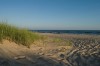
Geographic popularity contests have been kind to the Lake Michigan shoreline this summer: The Indiana Dunes National Lakeshore has been named a top 10 urban escape by National Geographic. The distinction comes on the heels of another sandy hotspot, the Sleeping Bear Dunes in northwestern Michigan, named by Good Morning America as the most beautiful place in the country. The Indiana Dunes Lakeshore was lauded as an escape from nearby Gary, Ind., and Chicago because of its 15 miles of lakeshore, biodiversity, and dunes that offer panoramic views of the lake.  The “Top 10 Urban Escapes” list is part of National Geographic’s, “Ten Best of Everything — National Parks,” book. Nearby communities are banking on their unique shoreline with a recent redevelopment plan dubbed Gateway to the Indiana Dunes.  The collaboration of dune towns is designed to spur development complementary to the natural resources and beauty. They have something to build on as 2010 was a record year for the dunes with 2.2 million visitors – an all-time high

So if you’re tired of staring at buildings and breathing city air, northwest Indiana wants you.

Message in a bottle or hoax in a newspaper?

Warning: Do not read if you’re a young girl who recently received a response to your message in a bottle. A recent feel good story in The Times Record in Maine reports that a 6-year-old girl and her father sent a message in a plastic bottle down the Kennebec River in Bath, Maine, two years ago.  The girl, Libbi Wallace, recently received a response letter, post-marked from Cleveland, from an anonymous kayaker who paddled upon the bottle.  The responder — who signed the letter only as “Surprised in Cleveland” — said he or she found the bottle while kayaking in Lake Erie. Hmmmm … A Times Record reporter browsed an atlas with the river-littering pair, and the father offered a possible route: St. Lawrence River to Lake Ontario to Lake Erie.  While I didn’t go into journalism to make children cry, I have to point out a couple problems with pop’s reasoning:

First, the Kennebec River flows south through Maine emptying into the Atlantic Ocean, not north to the St.

Lake Erie water snake slithers off the endangered species list

A nonpoisonous Lake Erie water snake is no longer listed as a federally endangered species. The snake’s numbers plunged as more people settled Lake Erie’s western islands, according to the Toledo Blade. Populations rebounded after federal and state agencies protected inland and shoreline hibernation and breeding grounds. Earning federal protection in 1999, the water snake is the 23rd species to be delisted, according to the U.S. Fish and Wildlife Service.

Michigan indoor zoo lets you take home the exhibits

It sounds like a child’s dream and a parent’s nightmare: a trip to a zoo where you can bring home one of the cuddly reptiles. That’s the plan for the Great Lakes Zoological Society’s World of Discovery Conservation and Rescue Center set to open in September in Ann Arbor, Mich. The center will have exhibits, education programs for kids and a store for all of your reptile husbandry needs. It’s not alone in giving exotic species a home in the Great Lakes region.  The Wilds in southeastern Ohio has been a 10,000-acre sanctuary for endangered animals since 1991. The new indoor zoo will be full of reptiles, amphibians, fish and birds, many rescued.  While some will stick around the center for exhibits, others will be available for adoption.

University will help Great Lakes cities adapt to climate change

The University of Michigan is helping them with a new $1.2 million research project. Dubbed the “Great Lakes Adaptation Assessment for Cities,” the project teams researchers with city decision makers in five Great Lakes cities. They’ll provide the climate change science specifically for those communities.

VIDEO: How Many Sport Fish Can Lake Michigan Support?

Who’s eating whom in Lake Michigan? The emergence of a few bad actors has made it difficult to answer that question. That’s why University of Wisconsin-Milwaukee researchers are studying the impact of aquatic invasive species – specifically round gobies – on Lake Michigan food webs. Gobies are a ravenous and aggressive fish species that invaded Great Lakes in the early 1990s. They subsist on tiny bottom-dwelling organisms and feed on baby quagga mussels for a side dish, scientists say.