
By Julia Belden
Long before he became one of America’s most beloved authors, Ernest Hemingway found solace and inspiration in Northern Michigan’s pristine environment.
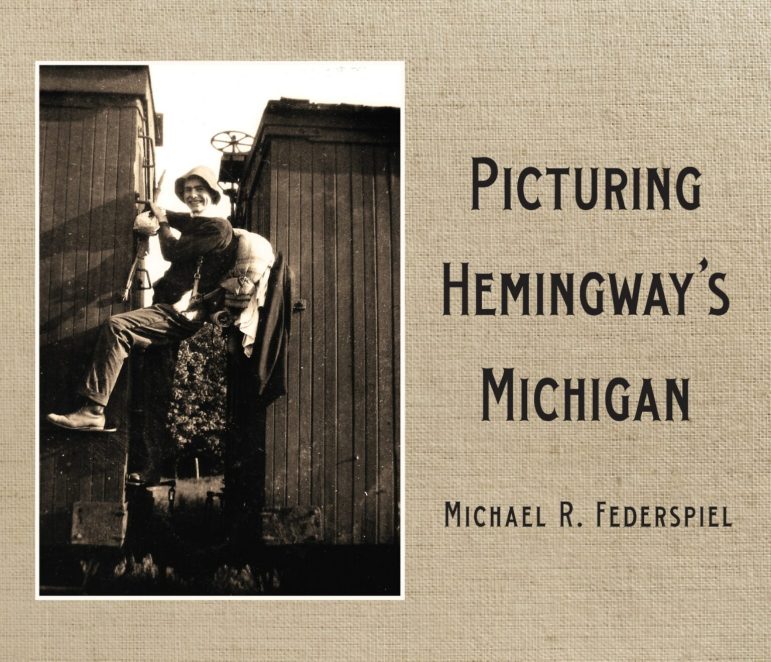
Hemingway’s Up North connection is detailed in Michael Federspiel’s “Picturing Hemingway’s Michigan,” (Wayne State University Press, $39.99). The book, first released as a hardcover in 2010 and now available in paperback, contains over 250 high-quality photographs of Hemingway, his family and the greater Petoskey area where they spent their summers in the early 1900s.
Federspiel’s interest in Hemingway’s Michigan experience began when he worked as a high school English teacher in Midland, convincing his ninth-grade class to slog through Hemingway’s classic “Old Man and the Sea.”
“What I discovered in a hurry was that a slow-moving story about an old man fishing in the Gulf Stream off the shore of Cuba had very little relevance to 14-year-olds,” Federspiel said.
He remembered the Hemingway family’s yearly pilgrimage from their Chicago-area home to their cottage on Walloon Lake, a tradition familiar to many Midwestern families.
“So I kind of jumped on that notion of ‘you 14-year-olds, you’ve been Up North in the summer. You know what it’s like to take vacations up there. Well, Hemingway did the same thing,’” Federspiel said.
“Those places that burn themselves into your memory as a child stay with you forever,” he said, adding that Hemingway was an “experience junkie” with a penchant for outdoor adventures.
“The Nick Adams Stories,” a collection of Hemingway’s short stories written in the 1920s and 1930s, features Northern Michigan locales and scenery.
Having grown up in Alanson, northeast of Petoskey, Federspiel was acquainted with many of the sites referenced in “The Nick Adams Stories.”
“I began to put the puzzle pieces together and learn more” about Hemingway’s time in Michigan, Federspiel said.
In 2007, the Michigan Humanities Council chose “The Nick Adams Stories” for the first Great Michigan Read.
Through his involvement with the Michigan Hemingway Society and the Clark Historical Library at Central Michigan University, Federspiel helped secure grant funding from the council for additional materials to support the Great Michigan Read.

Federspiel gathered images and historical documents for the education materials, which involved traveling to the Kennedy Library in Boston to leaf through its Hemingway collection. “Picturing Hemingway’s Michigan” is the result of this work.
Like the original hardcover edition, all author profits from the 2025 paperback support the Michigan Hemingway Endowment, a fund supporting the Clark Historical Library’s acquisitions of Hemingway materials.
The book is split into three parts: The first section provides an overview of Northern Michigan during Hemingway’s time, the middle section focuses on the Hemingway family and the final third centers on Ernest Hemingway himself.
Although Hemingway stopped visiting Michigan after his early 20s — he returned only once in his later years – he continued to draw inspiration from his time Up North.
Hemingway “tacked a map of Michigan on the wall” when he lived in Paris in the mid-1920s, Federspiel said. “His mind was back in Northern Michigan.”
Michigan is an ideal place for “Hemingway tourism,” Federspiel said, because much of the landscape remains unchanged since Hemingway’s day.
For those interested in learning more about Hemingway’s time in Michigan, Federspiel recommends visiting the Little Traverse History Museum in Petoskey, or, for the more adventurous, taking a self-guided driving tour of Hemingway’s Up North haunts.