
By Ada Tussing
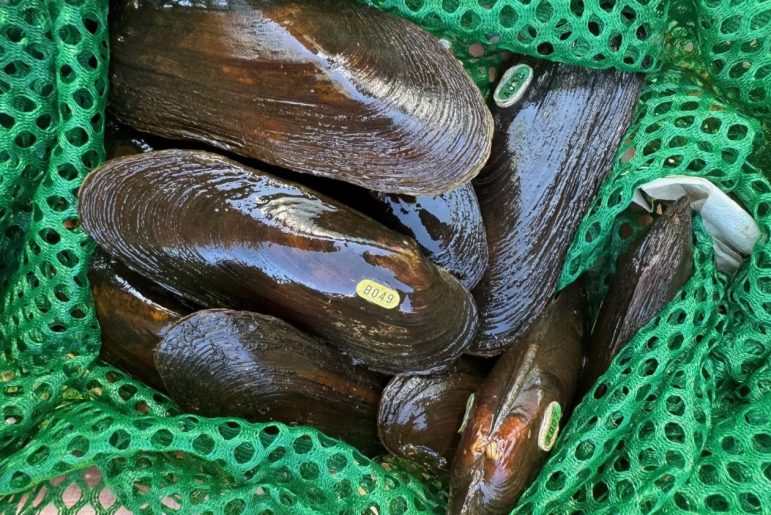
To combat the population loss of spectaclecase mussels, researchers with both the Minnesota and the Wisconsin Department of Natural Resources released over 177 mussels into the Chippewa River in Northwest Wisconsin.
The spectaclecase (Cumberlandia monodonta) once lived in 44 streams across 14 states in the Mississippi, Ohio and Missouri River basins.
Today, however, it is found only in 20 streams across 12 states. This population decline is likely due to the increased number of dams, affecting the seasonal flow of the rivers, according to the U.S. Fish and Wildlife Service.
The spectaclecase mussel was first listed as endangered under the U.S. Endangered Species Act in 2012.
The mussels rely on highly specific conditions to reproduce, so their reintroduction is not an easy task.
Jesse Weinzinger, an aquatic zoologist at the Wisconsin DNR, says the mussels need a “host animal” to spread their population.
“A female mussel can produce hundreds of thousands of offspring,” he said. “Instead of internalizing – internally raising and brooding – these little, tiny, microscopic babies, she attracts a host animal.”
That animal, typically a fish, will absorb the female’s offspring (called “glochidia”) in their gills and carry them from one to four weeks. This process leaves the fish unharmed.
“It’s just a natural parasitic effort from the mussel to maximize survivability and maximize production of offspring,” explained Weinzinger.
Their reliance on another species for reproduction is one of the many reasons their populations don’t expand as rapidly as harmful species like zebra and quagga mussels, which do not require host animals.
These invasive mussels reduce the amount of food available for other fish and zooplankton.
As well, zebra mussels often latch onto other mussels, “rendering the native mussel immobile and unable to survive,” according to a report by the Michigan Invasive Species Program.
“Without that host animal to keep your populations in check,” said Weinzinger, “they can explode out of control.”
The process for finding the most suitable host animal for the spectaclecase mussels began in 2017 at the University of Minnesota.
“I think they tested over 100 fish, amphibians and other species,” said Weinzinger. Finally, they found a match in mooneye, a fish living in the same rivers as the spectaclecase.
Following that discovery, the Minnesota DNR propagated and grew specimens of the mussel until they reached a proper size for release.
Weinzinger explained how the Wisconsin DNR then, in collaboration with the Fish and Wildlife Service, “determined that the Chippewa River was a suitable site to release these animals because of improved water quality over the years, of the abundance of fish species and the presence of other federally and state-listed mussel species.”
After determining the host, location and growing specimens, the releases began.
The process has spanned multiple years, with the most recent release in October reintroducing mussels to the river.
“This is all part of a greater federal effort by the Fish and Wildlife Service to delist or take the spectaclecase mussel off the Endangered Species Act list,” said Weinzinger.
Spectaclecase mussels aren’t the only endangered bivalves targeted for reintroduction.
“We released another mussel species called the Higgins eye, which is also federally endangered,” said Weinzinger, “We released about a thousand of those a couple of weeks ago.”