
By Camila Bello Castro
Racial and social factors which are a big part of Detroit’s “abandonment tourism” tend to be overlooked and silenced over profit and investment opportunities, a new study from the University of Geneva in Switzerland says.
Aude Le Gallou, a researcher at the university’s Department of Geography and Environment, came to that conclusion from nine visits on the “Explore Detroit Tours” in which she interviewed 52 tourists and the owner of the business.
Le Gallou kept the owner’s name anonymous in the study and called him “Thompson” instead.
She wrote, “Created by photographer Thompson (the name has been changed), the ‘Explore Detroit Tours’ specialized in Detroit’s abandoned places.”
The five-hour tours ran on weekends and cost $75 each during her visits between July 2017 and May 2018. The company closed in 2019 because its attractions disappeared due to renovations and demolitions, the study said.
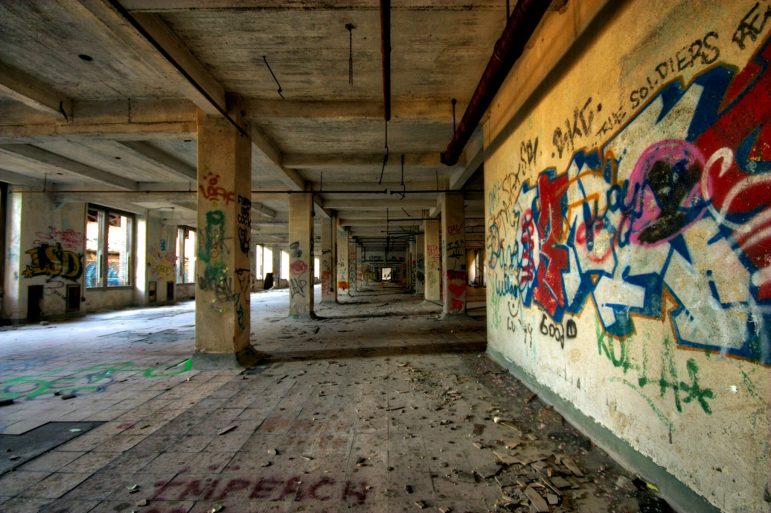
Visitors started in Detroit’s West Village and took a minibus journey to three to five sites, including former schools, churches and industrial and administrative buildings, the study said.
During Le Gallou’s fieldwork, the most-often visited sites were Thomas Cooley High School, St. Margaret Mary church and school, American Motors Corp. headquarters and the Continental Motor Plant, the study said.
“Notably, iconic Detroit ruins such as Michigan Central Station and the Packard Automotive Plant were no longer part of the tour due to increased security measures,” it said. Thompson sometimes stopped near the abandoned Packard site for a brief comment but with no time to explore it.
Le Gallou described tour participants as people with “profiles that differed in several respects from the broader tourist demographics of Detroit’s metropolitan area. They were younger, more international and largely composed of first-time visitors.”
She found that about one-third were from Michigan other than Detroit and none self-identified as African American.
“Taken together, these observations suggest an exoticization of Detroit’s ruins not only by international visitors but also by geographically proximate residents – albeit from more affluent socio-economic backgrounds,” Le Gallou wrote.
Her article appeared in the journal Social and Cultural Geography.
“This aligns with the notion of ruins as ‘sites of confrontation’ between tourist and resident understandings of Detroit’s abandonment,” she said.
The study quoted an unnamed long-term African American city resident expressing “a sense of loss, anger, and injustice,” saying, “People here have nothing to do with that. It’s disgusting. That ruin porn, it is really porn. It’s not cute, it’s not funny, it’s people’s lives destroyed.”
In an interview with Le Gallou, Thompson said he avoided talking about political and/or racial issues on his tours.
“I don’t think it’s ever a good idea to talk about – with business, because I’m in business – it’s never a good idea to talk about politics, racial issues,” he said.
Thompson, who is white, acknowledged the existence of racial inequalities in the city but downplayed their significance, Le Gallou said.
She said that he had “ limited understanding of the racial dimension of Detroit’s urban crisis” because of a “lack of cooperation with better-informed actors” and because of his background.
“While he cannot be blamed for not offering a historical account, his interpretation remains questionable: It reflects a suburban white perspective that frames Detroit primarily as an investment opportunity, while overlooking the complexities of its decline and redevelopment,” Le Gallou said.
“He benefited from the material and symbolic consequences of an abandonment,” she said.