By Anna Barnes
The Detroit River serves as an important geographic feature, connecting Lake St. Clair and Lake Erie and creating a natural border between the United States and Canada.
Despite the river’s physical prominence in the city of Detroit, its rich cultural significance is lost among much of the community.
David Porter, a professor of English and comparative literature at the University of Michigan, founded the Detroit River Story Lab to address this disconnect.
He was inspired by other Detroit-area organizations whose missions included restoring the river’s ecology and cultural identity.
These organizations “were very concerned that young people in particular were not aware of the many ways in which the river was a very important part of their community’s heritage,” Porter said.
As a professor of literature, Porter has a lot of experience with stories, but he had never heard the word used in the context of human-nature relationships.
“I became intrigued by the way that term was being deployed in a natural resources context and intrigued by the possibilities of exploring partnership opportunities between the university and some of these community organizations,” he said.
Porter realized in using this sense of the word, these stories could foster connections which, in turn, could revitalize stewardship and restoration attempts for the river. The project launched in 2020 and has grown since, with partnerships made along the way, including one with the city itself.
By putting the community’s stories at the heart of the project, Porter said he believes residents will gain a sense of stewardship through building a narrative infrastructure – the platforms and channels of communications where these stories are shared.
“Our narrative infrastructure efforts are divided into three buckets,” he said. “One is place-based education, the second is community journalism and then the third is public heritage.”
Porter wrote an essay explaining those three buckets and their value to the community.
Place-based education focuses on local youth, while community journalism and public heritage expands to the entire population.
He addresses an observation by academic environmental literature that may explain the reason for such a disconnect between the surrounding communities and the river: Environmentalist groups historically are predominantly white and the racist attitudes of some of their founders have been widely publicized in recent years.
When environmentalist groups stress the need to protect “our” forests and other natural resources, that messaging may not feel inclusive to communities that have historically felt left out or in danger in these spaces, according to Porter’s essay.
Porter said fostering stewardship for the Detroit River may be achieved by “providing fresh sorts of avenues for people to build a sense of connection and connectedness with these waterways that might be more salient to them than the points of connection offered by traditional environmentalist discourse.”
That discourse “is less resonant with traditionally marginalized communities than with white liberal types,” he said.
This idea is especially prevalent in light of the river’s history.
Jordan Irving, the director of the Detroit River Scholars Program and the Detroit River Youth Leadership Council, both of which are programs under the Story Lab, became involved in the project after meeting a mentor who introduced her to Porter.
The Story Lab uses community experts like Irving to lead the programs, experts who grew up in Detroit and have diverse backgrounds, perspectives and knowledge of the topic.
Irving is a leader of the project’s place-based learning aspect and said she was originally part of the Detroit community that didn’t know the history of the river, even after living next to it for the best part of a decade.
“From my own digging and searching about Detroit, I was able to learn about how, although Michigan was a free state during the 1800s, the fugitive slave laws had been enacted,” she said.
“That meant even if a slave made their way to Michigan, if they were caught, then a bounty hunter or their slave master could take them back into slavery. Therefore it really, truly wasn’t safe.”
Because of this practice, the river became a transfer point for those using the underground railroad. George DeBaptiste, a free Black man, used his steamboat to hide and transport escaped enslaved people across the Detroit River on their way to Canada, Irving said.
“Detroit was essential with getting enslaved people to freedom, and that information was new to me at one point,” she said.
“I’ve been sharing it with the young people, and it has deepened my relationship and my connection to this place that I’ve lived my whole life. I believe that they, too, are now feeling more connected to this place because they have a foundational history of what has transpired on this land.”
As the director of these programs, Irving is primarily involved in the place-based education sector of the Story Lab where she has accompanied students on outings.
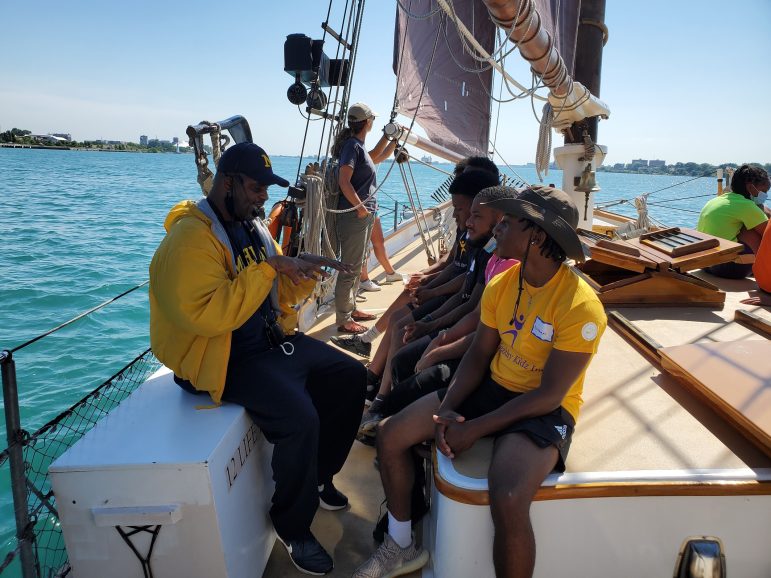
Irving said a partnership with the Inland Seas Education Association has allowed young people to learn about water ecology, species, quality and boating, all while sailing the Detroit River on schooners.
The history of the river was included in these circuits.
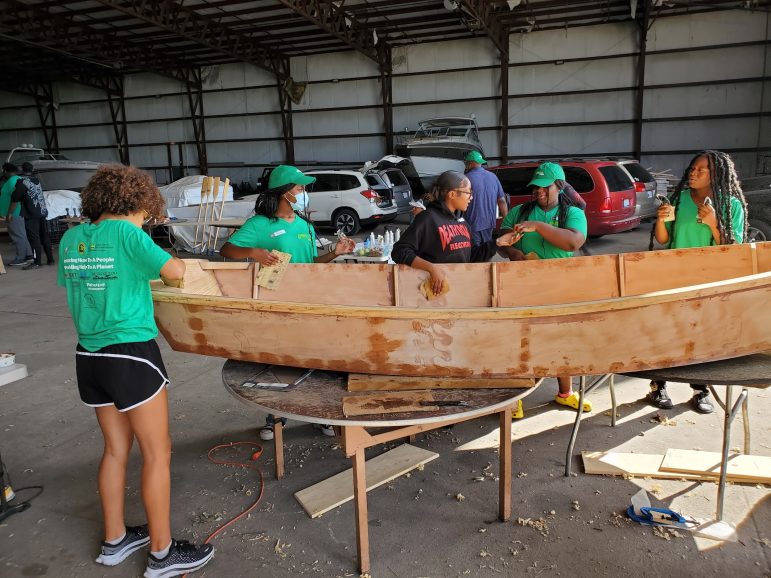
Soon the Great Lakes Boat Building School got involved with the partnership, and together they offered a free five-day trip sailing through lakes Michigan, Huron and St. Clair and the Detroit River.
The program was offered for three years and taught students boating skills.
“From the first year of the Detroit River Scholars Program came the Detroit River Youth Leadership Council,” Irving said. “That was born because after year one, students were like, ‘What’s next? We want more.’”
She said some students had never fished before but were now looking to take action and start their own projects.
“Most Detroiters, myself included and I’m in my 30s, did not know the history of the Detroit River,” she said. “It is a long and rich history as it pertains to our Indigenous culture, as it pertains to African-American culture and many enslaved folks’ voyage to freedom.”
“They’re being exposed to information and experiences in their hometown that they’ve never been privy to,” she said.
She said the exploration of hometown stories is growing the students’ sense of pride and stewardship. and that’s why they are now asking how they can take action.
Irving said she hopes to eventually travel with them nationally and internationally to conferences to change the narrative about Detroit.
“For forever, Detroit was called things like the ‘Murder Mitten,’ a lot of derogatory terms were associated with Detroit,” she said. “But it’s not like that. It’s a beautiful place to live and raise a family. I want other people around the world to know that.”
While Irving focuses on place-based education, the Story Lab has other sectors which appeal to wider audiences, including a local journalism focus. The associated podcast, Detroit River Stories, can be found on the Detroit River Story Lab website along with its other events and programming.
Porter said he believes the combination of local journalism, place-based education and community heritage will help communities surrounding the river become connected and comfortable in a space they historically haven’t been.
Stewardship for the waterway might just follow close behind.
“We protect what we love,” he said.