By Clara Lincolnhol
Capital News Service
The Michigan Department of Transportation is developing a plan to potentially construct the state’s fourth passenger rail route.
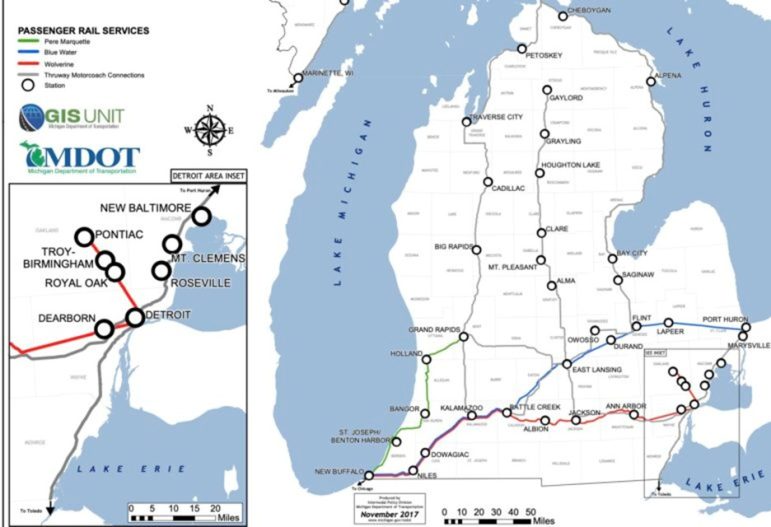
The proposed east-west route would carry passengers across the Lower Peninsula, connecting Holland and Grand Rapids with Detroit.
MDOT plans to work with a consultant to study the proposed route and interact with businesses and people along the corridor, said department Director Bradley Wieferich.
“The actual study will probably be kicking off in the spring of 2026, so six months from now,” Wiefereih said.
The prospective route would go from Holland on the west side of the state through Grand Rapids to East Lansing and eastward, with other stops still to be decided. Among the questions is whether the route would go through Howell or Jackson on its way to Ann Arbor and Detroit.
“We want to make sure this route works in context with all of our other passenger rail services,” said Wieferich.
The state does not receive any federal money directly for passenger rail service, raising the question as to where the money for the project would come from, he said.
“We’re going to have to talk about what opportunities there would be for funding,” he said. “There’s not a lot of funding set aside for this today, so we’d have to figure out how that would actually happen.”
The three existing passenger rail services in Michigan are also being looked at for opportunities for improvements or efficiencies, he said.
Those other routes operated by Amtrak are the Wolverine between Pontiac/Detroit and Chicago, the Blue Water between Port Huron and Chicago, and the Pere Marquette between Grand Rapids and Chicago.
The existing rail corridors are maintained through state taxes, said Tom Fletcher, chair of the Michigan Association of Railroad Passengers.
“A lot of the funding comes straight from the Michigan taxpayer,” he said.
The state paid Amtrak $15.2 million last year to keep the trains on the rails through state partnership programs. Funding for rail projects other than state tax dollars comes from federal grants which MDOT applies for, according to the department’s Office of Rail.
The idea to construct a coast-to-coast rail line has been around for years, Fletcher said.
“We think it’s a great idea linking some of the largest cities in the state together on a common rail route. It just makes too much sense,” Fletcher said.
Robust public transportation like the proposed rail line offers social and economic benefits to the areas it serves, he said.

“You end up with communities popping up along rail lines, apartment buildings and commercial enterprises, when you link centers of population together and help them be mobile,” Fletcher said.
The rail line would be helpful for traveling Michigan college students and make it easier for people who need medical care to get to hospitals. It would also help offset congestion on state highways, he said.
“I would much rather climb on a train and visit Chicago than deal with I-94 and find a place to park,” he said.
Passenger rail and public transportation help make communities more walkable, which is crucial for a healthy economy in a city, said Rick Harnish, the executive director of High Speed Rail Alliance in Chicago.
Areas with commerce located close together and people can easily walk to and shop generate more money for a city than large shopping centers, Harnish said.
Passenger rail is more environmentally friendly in the long run than car travel on highways, he said.
“Car tires are highly toxic – they get rubbed off onto the road and then the rain comes and washes [pollutants] down into our streams,” Harnish said.
A rail system takes up less space than a highway and can carry 12 times as many passengers as one highway lane can, he said.
“We have this problem that, for some reason, Americans think that the highway system we’ve had for one or two generations is the way God intended things to be,” Harnish said.
He said he thinks the east-west rail line in Michigan would be popular among residents, and a way to ensure that is by offering reliable, on-time service.
“I think that as the Legislature is working on how to increase highway funding. They need to start taking trains seriously,” he said.