

By Rachel Lewis
The Michigan Invasive Species Program is asking the public to be on the lookout for the invasive Asian longhorned beetle.
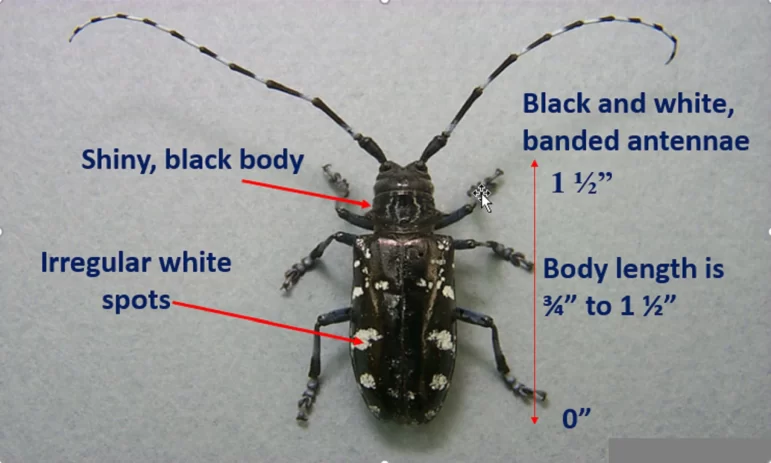
The inch-and-a-half long black beetle with white spots and long antennae is known to attack at least 12 species of hardwood trees, including maples, elms, horse chestnuts, birches and willows.
Although the beetle has not yet been found in Michigan, the state Department of Natural Resources said the earlier they are found, the easier they are to eradicate.
It’s a large, shiny black beetle with irregular white spots and black-and-white, banded antennae.
Cheryl Nelson, a forest health outreach forester at the DNR, said the only way to get rid of them is by completely removing their host trees. This has radically changed landscapes in other states with invasions.
Females will lay eggs in the trees so deeply that chemicals or other pesticides cannot reach them. Then the larvae will tunnel throughout the tree until they reach adulthood, where they will chew their way out, leaving a 3/8 to ½ inch hole, according to the DNR.
Although Michigan does have many native beetle species that look similar to the Asian longhorned leetle, the size of the tree holes are specific to the invasive beetle.
“None of our native species of beetles will leave an exit hole that size,” Nelson said. “If you see anything large like that, that’s important. Stop, take a look, take photos and report.”
Material resembling wood shavings at the base of a tree or tree branches is a sign of infestation.
She added to look out for fallen branches after a storm, which could be a sign that the tree has been weakened by the larvae.
The DNR says to report any sightings to its hotline, 1-866-702-9938, or the Asian Longhorned Beetle webpage.
One of the main ways the beetle can travel is through firewood, according to the DNR. Nelson recommends not transporting firewood, especially if it comes from an infested area.
“The way Michigan would get it most likely would be if it were brought in through infested firewood,” she said. “Just be aware not to bring any sort of firewood back and avoid bringing it to Michigan or anywhere outside of the infested area.”
Nelson emphasized that because the beetle has so many species of host trees and no native predators, catching them early on will be vital to stopping their spread.
“Because it has such a wide range of tree species that it likes, it’s all the more important to find it earlier, to prevent the loss of a lot of trees in an area,” she said.
This story was reported as part of a collaboration of Michigan Public, the Mott Foundation and MSU’s Knight Center for Environmental Journalism.