By Emilio Perez Ibarguen
Standing outside a bike shop on Cass Avenue on a Wednesday evening, Azizi Jasper admired the cycling community around him.
A group of about 30 people, diverse in age, race and experience level, had assembled outside the entrance to Back Alley Bikes. Some, like Jasper, were longtime riders familiar with navigating the city’s network of bike lanes, trails and streets. A handful were on their first-ever group ride.
“Cycling is one of those strange cross-cultural activities that literally brings all types of people together that otherwise may not be sitting at a table together,” Jasper said. “I think that’s the beauty of it.”
The popularity of groups like Wednesday Night Ride, Black Girls Do Bike and Soul Roll is an indicator that Detroit, long known for its ties to the auto industry, is making strides in becoming a cycling destination.
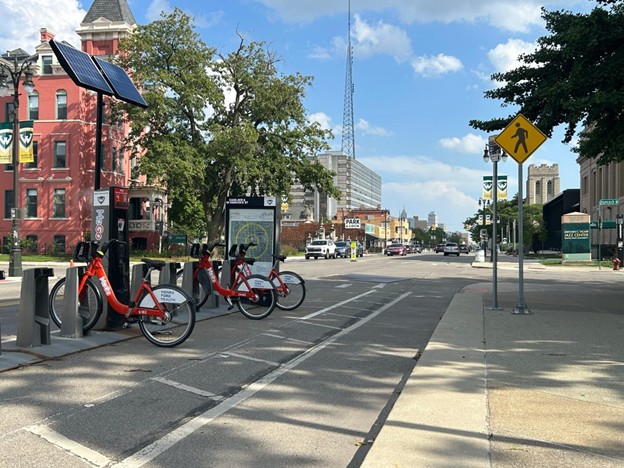
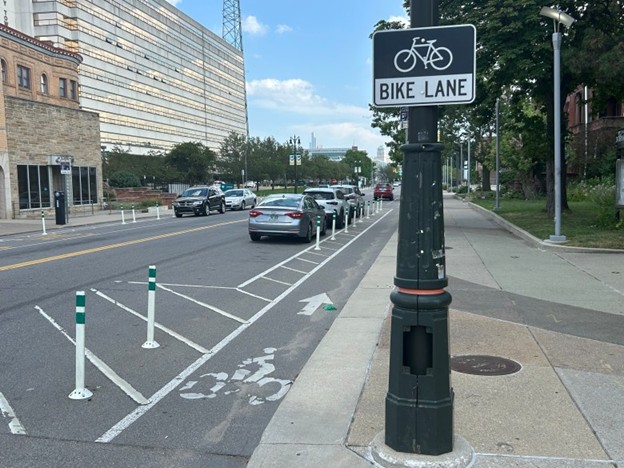
The city is connected by 164 miles of bike lanes (counting lanes on opposite sides of streets separately) 84 miles of shared lanes and roughly 29 miles of trails, according to the cycling advocacy group Detroit Greenways Coalition.
Approximately 84 miles of Detroit cycling paths are “share lanes,” where cyclists and drivers are asked to share the road.
The city has spent about $15 million installing bike lanes since 2011, Detroit Department of Public Works Director Ron Brundidge said
“The public right of way should be available for all to utilize,” he wrote. “Creating separated bike paths and bike lanes’ greatest benefit is that it provides an added layer of safety for all the bicyclists in Detroit.”
Cyclists will be able to ride into Canada and back when the Gordie Howe International Bridge opens later this year. The potential for cycle tourism across the border is one positive “social, environmental and economic” benefit for both countries, said communications manager Manny Paiva of the Windsor Detroit Bridge Authority.
High fatality rates a concern
The push to make biking more accessible seems ideal for a city where 34% of residents don’t have access to a car, according to a 2017 University of Michigan study.
But amid those milestones, Detroit streets remain unsafe for cyclists and pedestrians compared to other cities.
In 2023, Detroit had the 14th-highest cyclist fatality rate among cities with populations greater than 500,000, according to the National Highway Traffic Safety Administration. Its fatality rate of 0.47 per 100,000 residents was greater than the national average of 0.35, but lower than hotspots like Tucson, Arizona, and Sacramento, California.
Statewide, there were 1,480 bike-involved crashes in 2023, up from 1,340 in 2022, according to the most recent Michigan State Police data. Crashes involving pedestrians increased 11% in the same period.
In response to the high number of crashes across the state, Michigan lawmakers are considering upping the penalty for drivers who hit cyclists and pedestrians.
Bipartisan legislation approved by the state Senate in June and now before the state House would allow judges to sentence drivers who violate traffic laws and fatally hit a pedestrian or cyclist to a maximum of 15 years in prison. Currently, judges can deliver that sentence only if the traffic violation has a criminal penalty.
“I don’t think it will solve every problem or stop every accident, but it puts that tool in the toolbox so that we can achieve justice in certain cases,” said bill sponsor Sen. Sean McCann, a Democrat from Kalamazoo, where five cyclists were killed and four others injured in 2016 when a person driving a truck struck them.
Emilio Perez Ibarguen has an environmental reporting internship under the MSU Knight Center for Environmental Journalism’s diversity reporting partnership with the Mott News
Collaborative in cooperation with Capital News Service. This story was produced for Bridge Michigan.