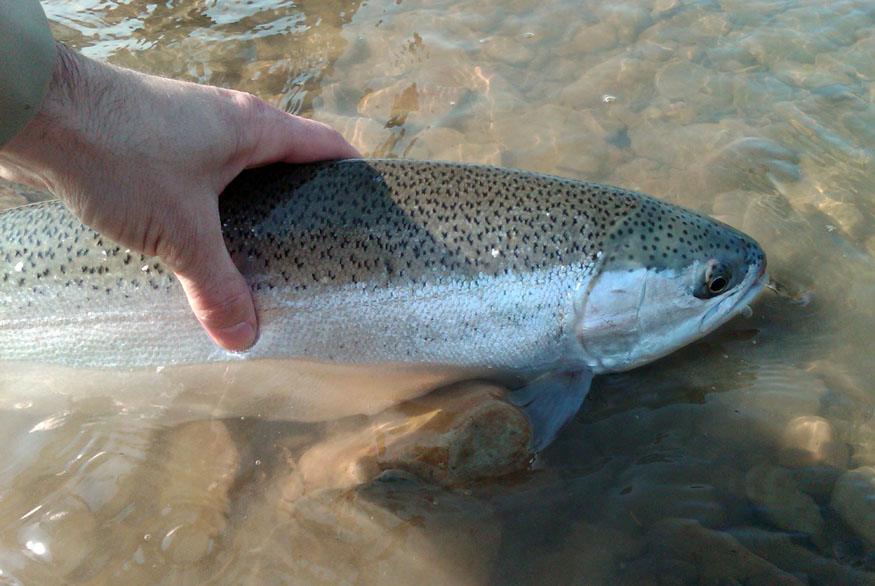
Lake Erie Steelhead. Image: Wikipedia Commons.
By Marie Orttenburger
Michigan’s Natural Resources Commission (NRC) recently banned scattering fish parts and eggs to lure fish on trout streams. Many anglers and guides are unhappy about it.
“It kind of drives me nuts,” said Chad Betts, owner of Betts Guide Service and Outfitters in Newaygo, Michigan
Known as chumming, the practice has long been controversial. Critics say it can cause disease and that it is an unfair way to catch more fish.
But some anglers don’t think those are reasons enough to categorically ban the practice on trout streams, as the NRC ruled to do in July.
They argue that the ban will deal a blow to Michigan’s fishing tourism economy.

Chum eggs. Image: Western Arctic National Parklands.
Chumming is helpful for fishing in the fall and winter months, when steelhead metabolism slows and the fish are less likely to bite. Guides like to use it to ensure visiting anglers have success.
“These people might have one day a year to fish,” said Eric Richards, owner and operator of Richards River Guide in Newaygo, Michigan, “[Chumming] is not a magic bullet by any means, but it is a nice tool to have in your arsenal.”
“We have customers who are saying they’re not going to come back,” after hearing about the ban, Betts said. He anticipates a 40-50 percent decline in fall and winter clientele.
Playing it on the safe side
The reason for the commission’s decision is chumming’s potential to harm the health of trout and salmon.
“There’s a lot of uncertainty around chumming,” said Nick Popoff, manager of the state Department of Natural Resources Aquatic Species and Regulatory Affairs Unit. “Generally, conservation decisions err on the side of safety.”
Popoff cited two studies as key contributors to the decision. One 2011 study investigated the potential negative impacts of using commercially cured eggs as bait. Curing eggs preserves them for longer use, but can involve chemicals that proved to increase mortality in juvenile salmon and trout. The other study, published in 1995, investigated the potential for disease transmission through eggs in Japan.
“There are other diseases that we currently don’t have in the Great Lakes that could be transmitted by eggs,” Popoff said.
The risks outlined in the studies combined with the state’s limited knowledge and regulation on chumming led the NRC to ban the practice on trout streams.
Supporters of chumming feel the studies don’t substantiate the ban. They prefer to see more region-specific scientific evidence that proves chumming is harmful.
“I don’t think those [studies] are representative of our ecosystem,” Richards said.
Chumming was banned in Michigan once before, from 2007-2012. There was concern then that fish eggs used for chumming in the Great Lakes could transmit Viral Hemorrhagic Septicemia (VHS), a fast-spreading disease that could quickly obliterate an entire species of fish. In 2012, the Great Lakes strain of VHS was found not to be transmittable via fish eggs, and the ban was lifted.
The practice came back into question after a recent increase in chumming to catch steelhead, followed shortly by an influx of complaints about it. State officials began considering how to regulate the practice in 2014.
Fair game
For Michigan Trout Unlimited, it’s a matter of fairness.
“We want the largest percentage of anglers going out to get [steelhead] to have some degree of success,” said Bryan Burroughs, executive director of Michigan Trout Unlimited. Unregulated chumming allowed some anglers to go home with 10-12 steelhead, he said, but others without a bite.
Chumming supporters compare it to using more effective tools in hunting. Those who choose more challenging methods will have more of a challenge.
“Just because [chumming] was more successful, is that really a reason to make it illegal?” Richards said. “You chose to fly fish. Fly fishing is a challenge.”
Richards and Betts both advocate for a restriction on how many eggs can be used to chum, which was one of the five options for chumming regulations discussed in the NRC’s meetings. The rest involved banning chumming on some or all trout streams. None of the options suggested specific regulations on egg origin or cure ingredients.
“It was an all-or-nothing approach basically,” said Amy Trotter, deputy director of the Michigan United Conservation Clubs.
“I don’t fault the commissioners, I think they had some valid concerns about disease and about the cures,” Trotter said. “What I would have liked was a little more creative thought as to how we can address those concerns rather than banning it.”
“But if we don’t have the information and data ready to go, then banning it was the only way to address those concerns at this point,” she added.
Trotter said she hopes that in the two years before the next Michigan DNR Fishing Guide is published, chumming supporters will help come up with solutions, and that the NRC will remain open to adjusting the regulation.
“We have to think through some mechanisms to actually enforce knowing where your eggs are coming from. Other states have done it. I don’t think that is insurmountable,” she said. “It certainly requires a little more work though.”
The practice is still allowed on other bodies of water.
Chumming throughout the region
For other Great Lakes states, chumming regulations center on the disposal of fish parts into bodies of water as litter. Wisconsin prohibits chumming unless an angler can retrieve the fish parts once he or she is done using them, by using a mesh bag, for example. Ohio has similar restrictions.
“It’s the unsanitary nature of disposing of those things,” said Jeff Collingwood, supervisor of the Ohio Department of Natural Resource’s Lake Erie Law Enforcement Unit. Disposed fish remains, he added, are unsightly, attract nuisance wildlife and eventually smell. But anglers can chum in any body of water so long as they clean up after themselves.
In Pennsylvania, “excessive” chumming is considered littering and therefore is illegal. The practice is completely banned in Minnesota and New York.