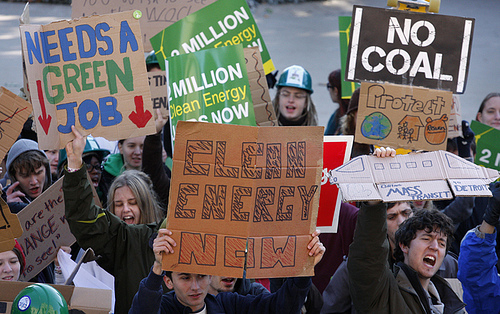
Green jobs advocates at a recent rally at Michigan's capitol in Lansing. Photo: Brian Laskowski
By Brian Laskowski and Agnieszka Spieszny
Detroit Workers for Environmental Justice runs a green-jobs training program for low-income or unemployed Detroiters, some of whom formerly worked for the auto industry.
Kinnus Paul said his organization boasts a 100 percent job placement mostly in hands-on clean-up work.
“You have to clean up before you green up” is the agency’s motto, the job developer jokes. Jobs include hazardous waste clean up, lead and asbestos abatement, weatherization installation.
But while Paul knows a green job when he sees one, government agencies tracking an activity they hope fuels the economy struggle with the definition.
The Federal Bureau of Labor Statistics will start tracking green employment in 2010, but still lacks a formal definition. Only four states — Oregon, Washington, California and Michigan — have official reports tracking green jobs in their states.
Those states generally count green jobs as the ones involving energy efficiency, renewable energy, pollution cleanup and conservation.
California also includes educational training.
Michigan officials define green jobs as occupations generating a firm’s green-related products or services. They include clean transportation and fuels. And the state counts other jobs supported by a firm’s green-related revenue.
So far Michigan is the only state to identify green support jobs, such as the secretary of a solar panel manufacturer. The Michigan Bureau of Labor Market Information found that there are 109,067 private sector green jobs in the state. The report identifies 96,767 jobs as direct jobs and 12,300 support jobs.
That accounts for around 3 percent of Michigan’s total private sector employment. Work on clean fuels and transportation accounts for most of Michigan green employment with 40.6 percent or 39,317 green jobs in the state. Renewable energy only accounts for 9.1 percent, or 8,843 jobs, of Michigan’s green labor market. A closer look at green firms discloses a promising growth rate for the renewable market of 30 percent since 2005.
Steven Kroll, an economist for the United States Bureau of Labor Statistics, said the federal definition is vast and still in the research stage. The bureau will try to reach a uniform definition with other governmental institutions such as the Environmental Protection Agency, Department of Energy, Congress and others. Both individual occupations and industries will be considered when the bureau starts tracking green employment next year.
The task is not easy. Green jobs may include jobs that previously existed, but are now considered green and also those that are used for training or teaching. For example, it’s possible the bureau will count a zookeeper as green because it is an occupation that conserves natural resources — animals, and also serves as an educational tool for the public.
“Chances are park ranger to secretary to purchasing manager for a park service will count as green,” said Kroll.
While definitions are determined on a national level, real numbers are hard to come by outside of the four states that already track data.
“There is a real lack of basic information on this topic at the state level,” said Bruce Weaver project manager for the Michigan green jobs report, “There’s no data base that delineates whether a job is part of a green economy versus something else.”
Definitions could be broadened to companies that are hired to improve another firm’s day-to-day operations or narrowed to include General Electric for the energy-efficient light bulbs it produces.
“If you look closely at a couple of studies they make assumptions or they are incomplete in some ways,” said Kroll. “Based on different definitions you may have different ways of measuring data.”