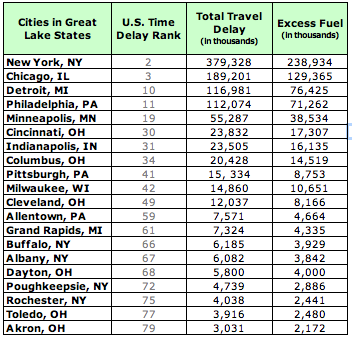
Source: Texas Transportation Institute
By Haley Walker
October 23, 2009
U.S. drivers as a whole spent the equivalent of 175 million days in traffic jams in 2007, according to a recent report.
That’s enough time to listen to War and Peace on your car stereo 160 million times, said the Texas Transportation Institute researchers who published the 2009 Urban Mobility Report.
It is a slight drop from 2006. “Congestion went down because of high gas prices in 2007,” said Tim Lomax, research engineer with the transportation institute.
While the economy and gas prices slowed congestion in 2007, the 25-year trend shows continual growth. The report has been published more than 15 times.
Chicago and Detroit are two of the most congested cities reported for the Great Lake region.
Poll: How much time
do you spend in traffic jams?
The report also says that in 2007, 2.81 billion gallons of fuel worth $87 billion were wasted in traffic nationwide. That’s an average loss of $760 or 24 gallons per traveler.
The report evaluates 439 urban areas nationwide. The 90 most populated cities were ranked in very large, large, medium and small divisions.
Of the 90 largest cities ranked, 20 were in the Great Lake states.
Los Angeles was the most congested city in the nation. The city’s average traveler spent 70 hours in traffic in 2007.
With more than 8 million people, New York City ranked second to Los Angeles in the nation, according to total delay, fuel consumption and congestion cost.
“The regional differences show up in year to year changes,” Lomax said. “Where we have seen slow downs, job declines, or run up in gas prices, is where we see congestion either not changing or decreasing.”
This is the case in Michigan. “With the economy, congestion is holding about the same, maybe a little down,” said Bill Shreck, director of communications for the Michigan Department of Transportation. “Three or four years ago, traffic was heavier.”
Detroit ranks 10th nationwide in total delay, fuel consumption and congestion cost. Another Michigan city, Grand Rapids, was also ranked in the top 90.
The report suggests solutions: more lanes and highways, better public transportation, diversified city development.
If public transportation had not been used in 2007, the 439 urban areas would have another 646 million hours in delay, according to the report.
Cost of solutions is an issue. “There are things we know we could do to relieve congestion but we don’t have the money to hold the current system let alone add to it,” Shreck said. “You don’t want to put an addition on your house when the roof is leaking.”
The authors of the report predict that good news for the economy is not good news for traffic jams.
“History has shown us that as the economy goes, so goes congestion,” Schrank said. “We have to be ready for the fact that it will worsen in the years to come.”
Related story: Best Great Lakes states for bicycle commuting.