Mosquitoes triple

If you live in Michigan it seems like every summer is a time to complain about the mosquitoes being really bad this year, but how bad are they, really? Current State talked with Ned Walker about this year’s mosquito crop and some of the issues connected to mosquito-borne illness. He’s a professor in MSU’s Department of Entomology and the Department of Microbiology and Molecular Genetics.

Upending the basin: Making data dance

Last week I covered the release of an animated model of an oil spill in the Straits of Mackinac. The greatest question it prompted in my mind: Why didn’t we do that? I’ll grant that the researcher who put that one together had studied Great Lakes currents for 30 years. Journalists aren’t going to replicate that kind of expertise. But journalists aren’t expected to generate the data.

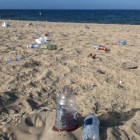
Beach cleanup no celebration

One piece of trash isn’t a big deal. Multiply that by the thousands that flock to the beach for firework events and there’s a big problem. Beach officials are left cleaning up littered beaches after Fourth of July fireworks.

New Ohio water coalition to poll public

 A coalition of Ohio farm, industry, government and environmental groups is rolling out a poll next week to assess which water issues are most important to the public. The new group is called Healthy Water Ohio or HwO. Its mission is to improve water supply, quality and treatment. The group’s steering committee will use the poll and focus groups to plan how to resolve Ohio water problems within the next 20-30 years, said John Stark, freshwater director for The Nature Conservancy. Because the eight counties along Lake Erie generates $38 billion in tourism for Ohio each year, HwO is concerned about water shortages, said Larry Fletcher,the executive director of Lake Erie Shores & Islands, a travel agency that belongs to the coalition.

Great Lakes exports mussels, advice and reporter to Texas

Clean, drain, dry is common advice among the Great Lakes boating community. Now it’s delivered with a southern drawl. The watercraft maintenance practice limits the spread of invasive species between lakes. And now it is used in Texas to limit the further spread of a Great Lakes menace threatening lakes in that state. Zebra mussels are again the target.  They entered the U.S. through the Great Lakes aboard freighters that inadvertently transported them from Eurasia.

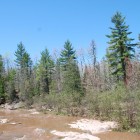
Photo Friday: Spring on the Baltimore River

Kate Clover of St. Paul, Minn. took this image of the Baltimore River in late May while hiking to O Kun de Kun Falls on part of the North Country Trail in Ontonagon County, Mich. The trail head is just north of Bruce Crossing. The river is muddy with find red sediment.

Starting a Great Lakes island trek – sneak preview

Great Lakes Echo recently interviewed Loreen Niewenhuis in the middle of her third 1,000 mile hike. She’s the author of A 1,000-Mile Walk on the Beach and A 1,000-Mile Great Lakes Walk. Both chronicle her hiking adventures around the Great Lakes. This time she is hiking, biking and kayaking on islands in each of the five Great Lakes. Read about it here LINK. Her third book, tentatively titled A 1,000-mile Great Lakes Island Adventure, is scheduled to be released in June 2015.

Michigan may authorize new uses for toxic coal ash

Michigan may authorize new uses for toxic coal ash by Great Lakes Echo

One of the bills that cleared the Michigan legislature this session was a provision that allows certain bio-waste materials to be re-used for beneficial purposes. These substances include things like cement kiln dust, wood pulp and coal ash. Coal ash is the leftover residue from coal burned by electric power plants. The bill permits coal ash to be used in road construction, but it may also be used in agriculture as a fertilizer supplement, causing some environmental advocates to become concerned. Current State’s Kevin Lavery speaks with Republican State Representative Wayne Schmidt, the bill’s main sponsor, who strongly states that coal ash is completely safe and does not pose any environmental threats.