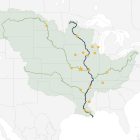
Click for descriptions of environmental education efforts. Larger map.
By Andy Balaskovitz,
abalaskovitz@gmail.com
Great Lakes Echo
June 29, 2009
Randy Showerman leads his boy scout troop out his back door and into the dark and silence.
There are no lanterns or campfires, no knot-tying or shelter-building lessons. Silence is key. He tells the scouts to stare at the sky and listen. It’s usually best between 10 p.m. and 11 p.m.
“Environmental education needs to begin with the kids having an understanding of their surroundings,” he said. “That means getting them outdoors.”
var addthis_language = ‘en’;
By Jeff Gillies, jeffgillies@gmail.com
Great Lakes Echo
June 26, 2009
A bizarre salamander and the endangered, clam-like mussel that relies on it got good news recently from Canadian scientists.
Federal researchers found an apparently stable population of mudpuppies in Ontario’s Sydenham River. The research is published in the June issue of the Journal of Great Lakes Research.
Mudpuppies are native to the Great Lakes and have beady eyes, slimy skin and feathery gills sticking out of their necks.
var addthis_language = ‘en’;
By Jeff Gillies
Great Lakes Echo
June 25, 2009
Here are couple of recent and on-going series on Great Lakes topics.
Dave Spratt of Great Northern Outdoors has written a good three-part series that tells the story of shifting food webs in lakes Huron and Michigan. Parts one and two look at the collapse of Chinook salmon and the rise of walleye in Lake Huron — changes driven by the impact of zebra and quagga mussels on the once abundant alewives.
Part three heads to Lake Michigan, where alewives are down but haven’t disappeared, …
By Allison Bush, bushalli@msu.edu
Great Lakes Echo
June 22, 2009
The prospect of traveling from Chicago to Detroit at 110 mph might be more feasible with the recent release of federal rules for obtaining a piece of the $8 billion in stimulus funds for the high-speed rail.
The criteria looks good for the Great Lakes region as it favors multi-state proposals. Regional transportation officials have proposed a high-speed rail with a central hub in Chicago that travels to Detroit, Milwaukee, Cleveland, Columbus, Indianapolis and other cities.
But will people give up their automobiles and make …
By Sarah Coefield, coefield@msu.edu
Great Lakes Echo
June 18, 2009
There may be hope for fishery managers still reeling years after a dangerous virus appeared in the Great Lakes.
The month-long wait for a viral hemorrhagic septicemia test has hobbled hatcheries that must test fish before introducing them to the region’s lakes and streams. Genetics researchers at the Lake Erie Research Center at the University of Toledo are working on a test that will speed up that diagnosis to a matter of hours.
The research, supported by the U.S. Department of Agriculture, is one of …
By Allison Bush, bushalli@msu.edu
Great Lakes Echo
June 17, 2009
Although a new federal report says global warming is already causing harm, many Americans believe it is tomorrow’s problem – that it won’t hurt people for another 10 years.
And those surveyed in five Great Lakes states are less worried than the national average, according to a recent study by the Yale Project on Climate Change and the George Mason University Center for Climate Change Communication.
The study found six levels of concern about warming caused by the burning of fossil fuels for energy and …
By Allison Bush, bushalli@msu.edu
Great Lakes Echo
June 16, 2009
Minnesota native and nationally renowned polar explorer Will Steger has watched ice melt practically under his feet in the coldest regions of the world.
“About 15 years ago, scientists predicted that changes in global warming would first be seen in polar regions,” Steger said recently. “So unfortunately, most of the changes people have not seen yet.”
But Steger, who has traversed both Antarctica and the Arctic, and has spent more than 40 years leading and participating in polar expeditions, says that he has seen the …