Archive for July 2010

Jul 30 2010 | | One Comment
Photo: Michigan State Police

Amid the media frenzy following the 800,000-gallon oil spill in the Kalamazoo River, some confusion is brewing over how much oil that is.
Specifically, just how deep it would bury a football field.
Reporter Tim Martin tried to contextualize the big spill this way Wednesday in an Associated Press article:
“An 800,000 gallon spill would be enough to fill 1-gallon jugs lined side by side for nearly 70 miles. It also could fill a wall-in football field including the end zones with a 14-foot-high pool of oil.”
News outlets from Indiana to Los Angeles …

Jul 30 2010 | | No Comments
Daley carp/oil rant

Chicago Mayor Richard Daley prompts an interesting question:

Is chemical or biological pollution the greater threat to Lake Michigan?

The mayor used the Kalamazoo River oil spill to attempt to turn the table on critics urging Chicago to close the route for invasive Asian carp.

Jul 28 2010 | | No Comments
Climate change is shifting walleye reproduction schedule, which could have the larval fish hatching when there's nothing to eat. Photo: Roger Klindt

Long-term warming of the Great Lakes climate is melting the ice from Minnesota lakes earlier in the year.

Jul 28 2010 | | 3 Comments
Picture 3

Listen to the story…

The oil spill in the Kalamazoo River is entering its third day. It started when a transcontinental pipeline ruptured near the town of Marshall. Governor Granholm was on site yesterday. And President Obama has pledged support. At least 19,500 barrels have flowed into the river and to the City of Kalamazoo. The story from Chris McCarus with Michigan Now:
People parked their cars next to 15 Mile Road bridge. It’s just west of the City of Marshall. Swift current carried black and blue plumes along the surface of …

Jul 28 2010 | | One Comment
July 28: Mr. Rogers' Garden

This week: Each summer, the Mr. Rogers Garden program trains dozens of at-risk youth to grow, harvest and sell vegetables at Flint’s Farmer’s market.

Jul 27 2010 | | No Comments
CARP_BOMB_ICON

Recently, five Great Lakes states sued the Metropolitan Water Reclamation District of Greater Chicago and the U.S. Corps of Engineers over the Asian carp issue.
But, shortly after that, a group of Great Lakes leaders — including Chicago Mayor Richard Daley — announced a plan to collaborate on a $2 million study to determine the best way to keep invasive species from moving between the Great Lakes and the Mississippi River basins.
It’s a scientific fact that nothing angers up the blood of Asian carp more than interstate cooperation. So it’s no …

Jul 26 2010 | | No Comments
Picture 2

The U.S. Geological Survey combined maps of geologic features (like rock types) and natural landscape features (like mountains) to make this tapestry map.

Jul 23 2010 | | One Comment
Click to enlarge. Photo: Charles Kerfoot/Michigan Tech

The Lake Michigan “doughnut” — a huge ring-shaped bloom of phytoplankton that circles the late-winter waters of the Lake’s southern basin — is disappearing.

Jul 22 2010 | | No Comments
John Niewoonder was named wildlife biologist of the year by the Midwest Association of Fish and Wildlife Agencies. Photo provided by John Niewoonder.

John Niewoonder was named wildlife biologist of the year by the Midwest Association of Fish and Wildlife Agencies. He’s a Michigan native and key author of the state’s new deer management plan.

Jul 21 2010 | | One Comment
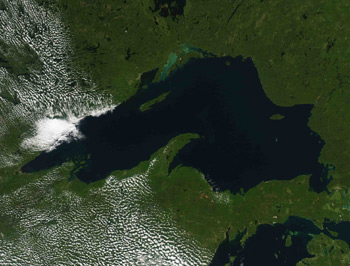
Decreasing ice cover and higher winds are likely contributing to Lake Superior's rapid warming. Photo: NOAA

Lake Superior has a fever, and the only prescription is a pile of media coverage.
The coldest Great Lake is around 15 degrees warmer than usual for this time of year and on track to beat its record high temperature of 68 degrees, reports ClimateWire’s Dina Fine Maron in the New York Times.
Over at the Great Lakes Town Hall, blogger Dave Dempsey recently pointed to a report on climate change in Lake Superior from the University of Minnesota Duluth’s Large Lakes Observatory.
The report (PDF) cites research findings that Lake Superior’s surface …